


UK - Viet Nam Summit on AI, fintech, commodity derivatives and logistics
The 2026 UK - Viet Nam Summit was held in Hanoi on August 12, focusing on fields that are creating new momentum for growth, including artificial intelligence (AI), financial technology, crypto assets, commodity derivatives markets and logistics.
Against the backdrop of bilateral relations being upgraded to a Comprehensive Strategic Partnership, the summit opened up additional space for turning policy discussions into concrete cooperation projects, thereby creating practical value for businesses and the economies of both countries.
Representing the UK were Martin Kent, His Majesty’s Trade Commissioner for Asia Pacific; Iain Frew, British Ambassador to Viet Nam; Alexandra Smith, British Consul General in Ho Chi Minh City; and representatives of 10 leading UK technology companies.
On the Vietnamese side, participants included Deputy Minister of Industry and Trade Phan Thi Thang; leaders and representatives of agencies under the Ministry of Industry and Trade, the Ministry of Finance, the State Bank of Vietnam and the Vietnam Banks Association; Bui Hoang Tung, Secretary of the Government Youth Union; and representatives of the youth unions of the Ministry of Industry and Trade, the Ministry of Foreign Affairs, the Ministry of Justice, the Ministry of Construction, the Ministry of Agriculture and Environment, the State Bank of Vietnam, the Government Inspectorate and the Government Office.
Expanding cooperation under the Comprehensive Strategic Partnership
Delivering welcoming remarks at the summit, Iain Frew, British Ambassador to Viet Nam, emphasized the significance of strengthening cooperation between the two countries following the upgrade of Viet Nam - UK relations to a Comprehensive Strategic Partnership.
He noted that technology, finance, innovation and digital transformation are opening up new opportunities for bilateral cooperation, creating favorable conditions for businesses from both countries to connect, share experience and explore new investment and business opportunities.
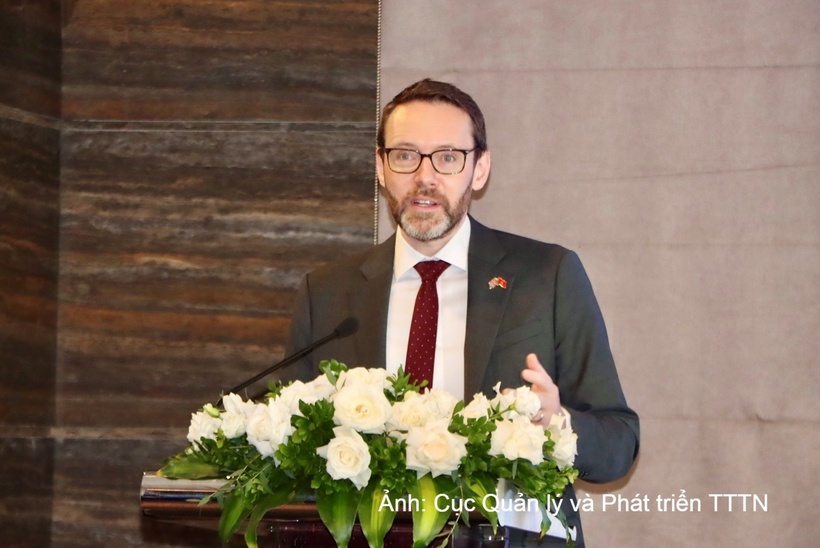
Iain Frew, British Ambassador to Viet Nam. Photo: MoIT.
Delivering the opening remarks, Deputy Minister of Industry and Trade Phan Thi Thang said the foundation of bilateral trade and investment continued to develop positively. In 2025, two-way trade reached a record high of nearly USD 9.4 billion. In the first seven months of 2026, bilateral trade amounted to nearly USD 6 billion, up 14.5% year on year. By the end of 2025, UK investors had 623 projects in Viet Nam with total registered capital of nearly USD 4.7 billion, concentrated mainly in finance, industry, energy, technology and logistics.
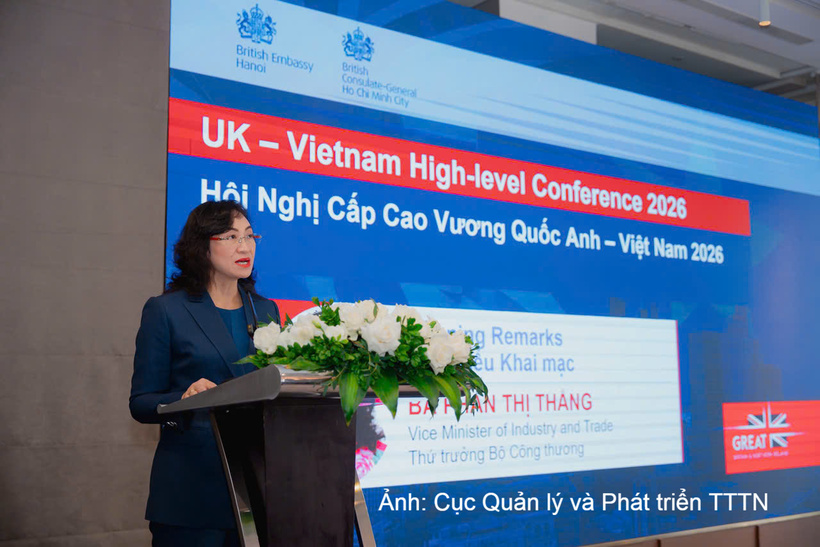
Deputy Minister of Industry and Trade Phan Thi Thang delivers remarks at the summit.
According to the Deputy Minister, the UK - Viet Nam Free Trade Agreement and the UK’s participation in the Comprehensive and Progressive Agreement for Trans - Pacific Partnership (CPTPP) continue to expand market space, strengthen supply chains and create favorable conditions for businesses from both countries to increase long-term investment.
The upgrade of bilateral relations to a Comprehensive Strategic Partnership, she said, is therefore not only a diplomatic milestone but also a new framework for deepening cooperation in economics, trade, investment, finance, science and technology, green transition and digital transformation.
AI emerges as a driver of productivity in the industry and trade sector
At the summit, a research team comprising Nguyen Ngoc Tam, MA, Nguyen Quoc Khanh, PhD, and Trinh Quoc Vinh, PhD, from the Youth Union of the Ministry of Industry and Trade presented a paper entitled “Applying AI and emerging technologies to improve labor productivity in the industry and trade sector.”
The presentation focused on clarifying the potential applications of AI and emerging technologies in key areas of the industry and trade sector, while also proposing solutions to accelerate digital transformation, improve operational efficiency and strengthen competitiveness.

Nguyen Ngoc Tam, Secretary of the Youth Union of the Ministry of Industry and Trade and Deputy Chief of Office of Agency for Domestic Market Surveillance and Developmen, shares her views.
Representing the research team, Nguyen Ngoc Tam, Secretary of the Youth Union of the Ministry of Industry and Trade, emphasized that labor productivity is a key factor determining the competitiveness of an economy.
In the context of the still-significant productivity gap between Viet Nam and several economies in the region, effectively harnessing AI and emerging technologies is considered one of the important directions for creating new momentum for productivity growth, renewing the growth model and strengthening the competitiveness of the industry and trade sector.
According to Nguyen Ngoc Tam, Viet Nam is gradually improving its legal and policy framework for science and technology development, innovation and digital transformation, laying the foundation for the safe and responsible application of AI. For the industry and trade sector, digital transformation orientations are focused on fields that play an important role in growth, including energy, processing and manufacturing, domestic trade, e-commerce, logistics and import-export activities.
The Ministry of Industry and Trade aims for the digital economy to contribute 20-25% of the sector’s total added value by 2030, while supporting 70% of industrial manufacturing enterprises in carrying out basic digital transformation. At the same time, the Ministry is pursuing targets related to data development, AI integration into public services, the use of virtual assistants in public administration and the improvement of AI application skills among officials and employees.
In e-commerce, AI can support personalized customer experiences, optimize operations and detect signs of violations, thereby contributing to the protection of consumer rights. In logistics, AI can help optimize transport routes, coordinate transportation activities, manage warehouses and reduce costs. For import-export activities, process digitalization, data connectivity and automated document processing continue to expand opportunities for trade facilitation, reducing both time and costs for businesses.
In the energy sector, AI is being oriented toward applications in load forecasting, optimizing system operations and supporting the integration of renewable energy sources.
For industrial production, AI, robotics and smart factory models are opening up new possibilities for automation, improving resource-use efficiency and supporting enterprises in implementing the “twin transition” of digital transformation and green transition.
AI, therefore, is not merely a technological tool. It is increasingly becoming one of the key drivers helping enterprises improve productivity and meet increasingly stringent requirements on traceability, emissions measurement and environmental standards in international trade.
Financial innovation must go hand in hand with discipline and safetyFrom the perspective of financial cooperation, Deputy Minister Phan Thi Thang emphasized that Viet Nam is entering a new stage of development that requires renewal of the growth model, higher productivity and more effective mobilization of both domestic and international resources.
In this process, the development of Viet Nam’s International Financial Center in Ho Chi Minh City and Da Nang is a strategic orientation aimed at forming a modern, transparent and competitive financial ecosystem aligned with international standards and serving the real economy.
Viet Nam highly values the UK’s experience in legal frameworks, governance, risk-based supervision, regulatory sandboxes and investor protection. At the conference on the International Financial Center held in Hanoi in March 2026, the UK shared experience in commodity derivatives markets, providing a foundation for the two sides to continue technical cooperation and develop specific products.
Regarding stablecoins and crypto assets, the Deputy Minister said these areas have the potential to support cross-border payments and finance, but at the same time raise issues relating to reserve assets, liquidity, user protection and financial stability. Viet Nam wishes to continue exchanging experience with UK regulatory agencies, including the Financial Conduct Authority (FCA), in a cautious, open and evidence-based manner.
According to the Deputy Minister, financial innovation should not be placed in opposition to regulation. What is needed, she said, is an appropriate regulatory framework that allows innovation to take place safely and responsibly while creating real value for the economy.
Developing derivatives markets in connection with the real economy
Another issue highlighted by Deputy Minister Phan Thi Thang was the development of commodity trading markets and derivative instruments in a transparent, safe, professional and internationally integrated manner. Acerivatives mDkets need to remain closely linked to physical commodities and the hedging needs of manufacturing and import-export enterprises.
Financial markets should not become detached from the real economy, while uncontrolled short-term speculation should not be encouraged. The objective is to help enterprises in sectors such as coffee, rubber, metals, energy, animal feed, textiles and garments, transport, and import-export activities gain access to pricing and risk-management instruments.
According to the Deputy Minister, this market has an organic relationship with the International Financial Center, where exchanges, clearing institutions, banks, insurers and technology companies can form an ecosystem operating in line with international standards. Alongside derivatives markets, logistics has also been identified as a promising area of cooperation.
Viet Nam is working toward building an integrated, modern, green and digital logistics system, reducing logistics costs and developing logistics centers with international competitiveness. This is an area that aligns well with the UK’s strengths in trade finance, marine insurance, port technology and supply chain management.
Turning dialogue into concrete cooperation projects
Based on the discussions at the summit, Deputy Minister Phan Thi Thang proposed four priority areas for UK-Viet Nam cooperation in the coming period.
First, the two sides should strengthen dialogue among regulatory agencies, financial institutions and businesses on legal frameworks for fintech, AI, data, cybersecurity and regulatory sandbox models.
Second, they should promote concrete cooperation projects at Viet Nam’s International Financial Center and nationwide, including green finance, trade finance, commodity derivatives markets, logistics finance, insurance and supply chain risk management.
Third, the two countries should develop joint human resource development programs involving state agencies, businesses and universities, focusing on management, compliance, cybersecurity, data science and the responsible application of AI.
Fourth, discussions at the summit should be translated into measurable partnerships, with businesses from both countries encouraged to identify specific challenges, launch pilot projects, evaluate the results and scale up effective models.
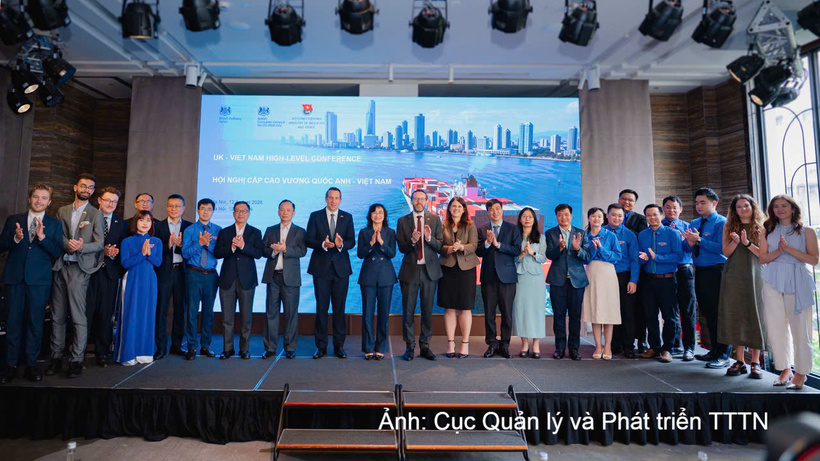
Delegates pose for a group photo at the summit.
From the perspective of the research team, Nguyen Ngoc Tam proposed strengthening the standardization and connectivity of shared data across the industry and trade sector; improving digital capabilities and skills for the responsible application of AI; and developing controlled testing environments for new technology models.
She also proposed making better use of the Viet Nam - UK Comprehensive Strategic Partnership framework to promote expert exchanges, technology transfer and investment attraction, while strengthening the competitiveness of Vietnamese enterprises.
In addition to specialized discussion sessions, the summit also featured presentations by UK fintech companies and business networking activities, creating opportunities for enterprises from both countries to directly introduce solutions, seek partners and expand cooperation opportunities.
| The 2026 UK - Viet Nam Summit demonstrated that the scope for bilateral cooperation is expanding from trade and investment into fields that have a direct impact on productivity and the competitiveness of the economy. With a focus on AI, fintech, finance, commodity derivatives and logistics, the summit pursued a clear objective: turning UK - Viet Nam cooperation from policy dialogue into concrete projects that create real value for businesses and the economies of both countries. |

