


‘Standardization - Elevation - Development’: The strategic axis of the industry and trade sector
More than a slogan, “standardization - elevation - development” is now a strategic axis for the industry and trade sector to adapt and drive long-term growth forward.
An action axis for the sector
At the 2025 conference of officials, civil servants and public employees held on March 19, acting minister of industry and trade Le Manh Hung designated 2026 as the year of “standardization - elevation - development” (Standardization - Elevation - Development) for the sector.
According to the Great Vietnamese Dictionary, standardization refers to the establishment of norms, ensuring that objects or systems conform to predefined standards. In this sense, standards are benchmarks used for comparison and as models.
Meanwhile, elevation means bringing an entity to a higher level in terms of quality, capability or position. This is not merely incremental improvement, but a process of value enhancement, strengthening competitiveness and affirming standing in a broader context.
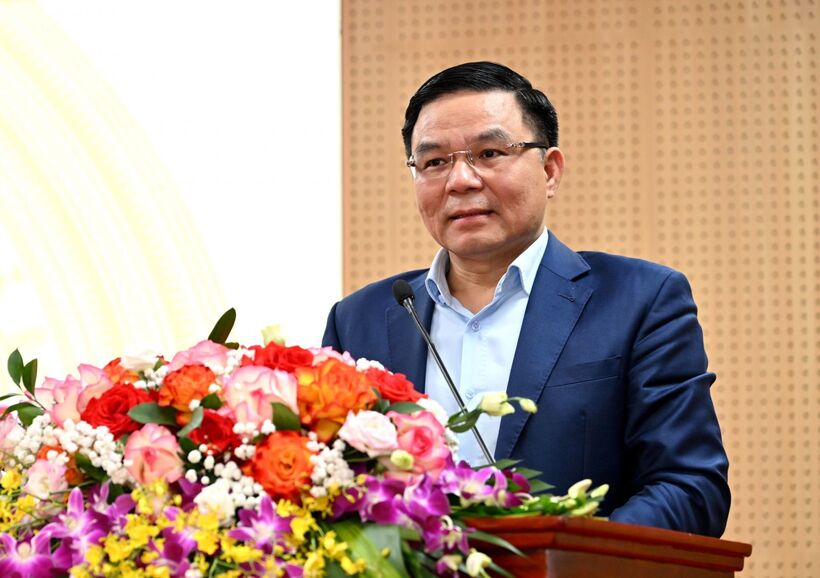
Acting Minister of Le Manh Hung delivers remarks at the 2025 conference of officials, civil servants and public employees of the Ministry of Industry and Trade.
Development is the process of transformation toward greater progress, completeness and expansion in both scale and quality. It goes beyond mere growth to encompass depth, efficiency and sustainability.
As 2026 marks the 75th anniversary of the industry and trade sector (May 14, 1951 - May 14, 2026), and as the sector enters a new phase alongside the country’s push toward double-digit growth, the message “standardization - elevation - development” is not only directional but also a call to action.
The three elements are not placed together by chance. They form a logical sequence of development: standardization provides stability, elevation builds strength and development enables breakthroughs.
Resolution of the 14th National Party Congress clearly emphasizes the need to transform the growth model toward productivity, quality, science and technology, innovation and digital transformation. In this process, the industry and trade sector plays a central role, directly linked to key pillars such as manufacturing and processing industries, energy transition and modern trade development. This requires the sector to enhance value-added production, develop energy systems, promote digital commerce and integrate more deeply into global value chains. The new growth model is therefore not only a general orientation for the economy but also a space for action and a leadership responsibility for the sector in the new development phase.
Over the years, the sector has achieved significant results, affirming its role as a pillar of the economy. However, rapid growth and a broad management scope have also imposed increasing demands for synchronization, discipline and operational efficiency. In this context, standardization is identified as a foundational step.
Standardization first involves completing institutions and policies in a synchronized, transparent and practical manner. Clear and consistent policies create confidence for businesses to invest and enable smooth market operations.
It also entails organizing and operating the apparatus in a scientific and efficient way. Each unit and individual must have clearly defined functions and responsibilities, minimizing overlap and avoidance. In addition, standardization extends to the workforce, from mindset and skills to professional conduct.
On that foundation, elevation becomes an inevitable next step. This begins with elevating governance thinking, shifting from administrative management to development facilitation, from passive response to proactive leadership. Enhancing capacity is also critical. Amid energy transition, digital transformation, the green economy and deep integration, officials in the sector must not only possess professional expertise but also interdisciplinary thinking and the ability to adapt quickly to change.
At the same time, elevation also means enhancing the sector’s position within the economic system. Beyond its regulatory role, the sector must lead in policymaking, market connectivity and shaping development trends. In this sense, standardization is the prerequisite for elevation, and elevation creates qualitative shifts toward more sustainable development.
Shaping new drivers for development
If standardization and elevation represent preparation and transformation, development is the ultimate goal. However, development in the current context is no longer understood as simple growth. It must be high-quality, in-depth and resilient to external shocks.
The sector is tasked with critical responsibilities such as ensuring national energy security, advancing industrialization, expanding export markets and maintaining major economic balances.
Amid global uncertainties, including geopolitical conflicts, energy price volatility and rising trade protectionism, the sector’s development requirements have become more urgent and complex.
Development must therefore be associated with self-reliance: in energy to reduce external dependence; in technology to enhance value-added; and in supply chains to strengthen resilience.
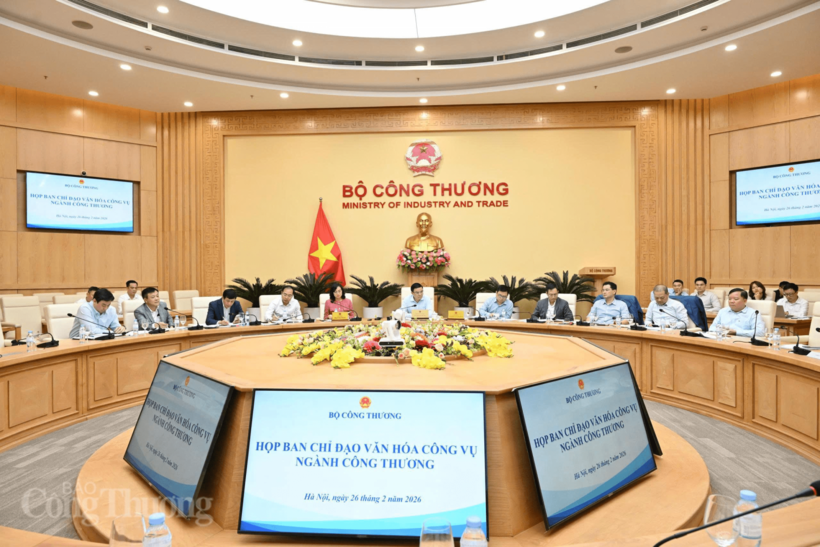
The setting of the Steering Committee meeting on public service culture development in the Ministry of Industry and Trade, held on February 26.
Notably, “standardization - elevation - development” is not a set of separate tasks but a unified whole. Standardization builds the foundation, elevation generates momentum and development delivers results. Without any of these elements, sustainable and effective development would be difficult to achieve.
At its core, the message lies in translating awareness into action. Each official, civil servant and worker in the sector is a key actor in this process. Standardization begins with doing the right things, fully and responsibly in every task. Elevation starts with a spirit of learning, innovation and willingness to act. Development is formed through consistent and sustained contributions from each individual across the system.
As the economy enters a phase of rapid growth, the sector is expected not only to maintain its pillar role but also to create new development drivers. “Standardization - elevation - development” is therefore not just a slogan, but a strategic orientation and an inevitable requirement of reality. It demands strong determination, collective unity and concrete, consistent actions. At the same time, it is the path for the sector to reinforce its role, elevate its position and contribute more significantly to the country’s fast and sustainable development.
Lessons from international experience
Looking at international experience, many developed countries have effectively realized the three pillars of “standardization - elevation - development”. Beyond awareness or orientation, they have translated these into coherent policies, governance models and consistent actions, thereby building solid foundations, enhancing competitiveness and ensuring sustainable development.
A common feature is that these countries begin with establishing standards, then gradually enhance capabilities and ultimately achieve deep, resilient development.
In Japan, standardization is implemented through advanced management systems such as Kaizen and 5S across production and public administration. The state enforces strict technical standards, transparent processes and strong discipline. As a result, Japanese products gain global trust, and businesses become preferred partners in international supply chains.
In the Republic of Korea, elevation is reflected in a selective industrialization strategy. The government concentrates resources on developing key conglomerates, invests heavily in research and development, education and technology. The country rapidly shifts from outsourcing to mastering technology, building global brands and elevating its position in value chains.
Germany demonstrates development in depth. It has built an industrial ecosystem based on high technology, stringent quality standards and highly specialized small and medium-sized enterprises. At the same time, it integrates industrial development with green transition and environmental protection, maintaining sustainable competitiveness.
These examples show that despite different approaches, countries converge on a common logic: standardization builds the foundation, elevation creates breakthroughs and development affirms position. This confirms that “standardization - elevation - development” is not only a theoretical orientation but a proven practical pathway for successful economies.
“Standardization - elevation - development” is an inevitable development logic: standardization lays the foundation, elevation generates momentum and development delivers outcomes. In the new context, the transition from slogan to concrete action will determine the sector’s competitiveness and position. This is not only an immediate requirement but also a pathway toward sustainable development and the continued affirmation of the sector’s pivotal role.

