


Viet Nam Department of Geology and Minerals holds legal conference in Lao Cai
A conference to disseminate legislation on geology and minerals and its implementing regulations was held in Lao Cai province on the morning of October 23.
The conference brought together leaders of the Viet Nam Department of Geology and Minerals under the Ministry of Industry and Trade (MoIT); representatives of the Departments of Industry and Trade of Lao Cai, Lai Chau and Son La provinces; local authorities; and representatives of agencies, organizations and enterprises operating in the geology and minerals sector.
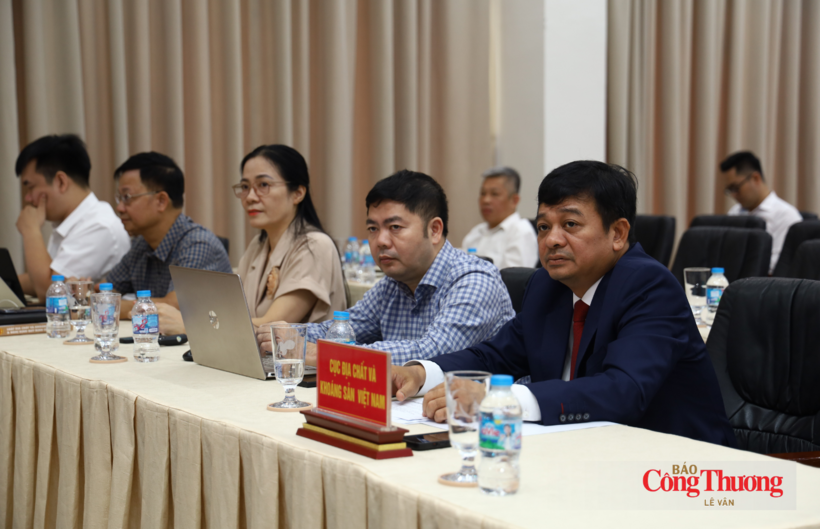
Delegates attending the conference.
In his opening remarks, Tran My Dung, Deputy Director of the Viet Nam Department of Geology and Minerals, emphasized that strengthening the legal framework governing geology and minerals is essential to improving the effectiveness and efficiency of state management and ensuring the rational exploitation and use of natural resources for socioeconomic development.
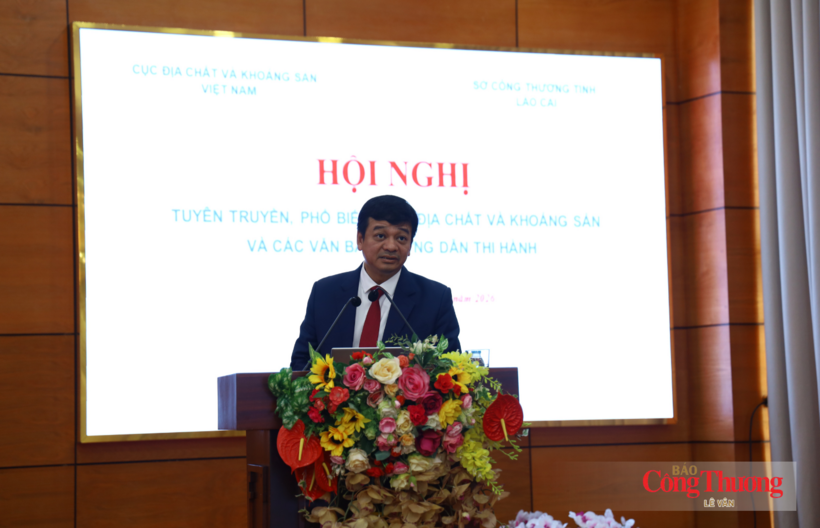
Tran My Dung, Deputy Director of the Viet Nam Department of Geology and Minerals under the Ministry of Industry and Trade, addresses the conference.
According to Dung, the Politburo's Resolution No. 10 on strategic orientations for geology, minerals and the mining industry through 2030, with a vision to 2045, identifies greater decentralization and delegation of authority to local governments as a key priority. These measures must be accompanied by stronger inspection, examination and supervision to prevent resource losses, combat corruption and protect the environment.
The 2024 Law on Geology and Minerals, as amended and supplemented in 2025, together with its implementing regulations, represents a concrete step towards translating these policies and orientations into practice. The process of developing and refining the regulatory framework incorporated feedback from local authorities, enterprises, organizations, individuals and experts in the geology and minerals sector, with the aim of addressing shortcomings arising in practical management.
To ensure that legal provisions are effectively implemented, Dung urged local authorities to proactively study and fully enforce the new regulations. He also called on localities to promptly compile and report difficulties and obstacles to the Viet Nam Department of Geology and Minerals for guidance and resolution. Particular attention should be given to facilitating mineral resource management, licensing and exploitation, while preventing shortages of construction materials for key projects.
Key provisions of the Law on Geology and Minerals for local authorities
At the conference, Pham Thi Thanh, Deputy Head of the Legal Affairs and Inspection Division under the Viet Nam Department of Geology and Minerals, outlined major changes to the legal framework governing geology and minerals, particularly those concerning the decentralization of authority, the settlement of administrative procedures and the protection of enterprises' legitimate interests during the transfer of state management functions.
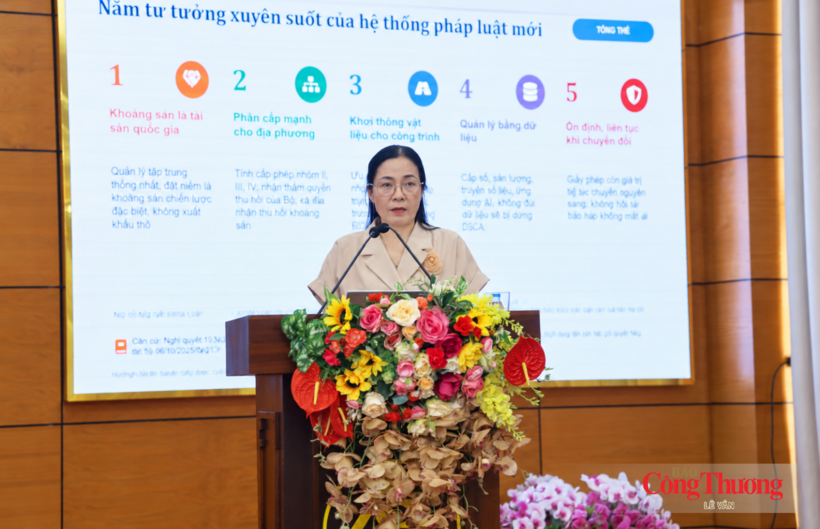
Pham Thi Thanh, Deputy Head of the Legal Affairs and Inspection Division under the Viet Nam Department of Geology and Minerals, addresses the conference.
According to Thanh, the current legal framework is based on the 2024 Law on Geology and Minerals, its 2025 amendments and supplements, implementing decrees and Government resolutions on decentralization and delegation of authority. Notably, state management functions concerning geology and minerals were transferred to the Ministry of Industry and Trade on September 15, 2026. Alongside this institutional transition, local authorities are required to clearly identify their respective powers and responsibilities, ensuring the uninterrupted processing of administrative procedures without disrupting the operations of organizations and enterprises.
Regarding decentralization, chairpersons of provincial-level People's Committees are authorized to issue licenses for mineral groups II, III and IV in accordance with regulations. From July 1, 2026, under Government Resolution No. 66.19/2026/NQ-CP, provincial-level People's Committee chairpersons were delegated authority over nine additional groups of administrative procedures in the geology and minerals sector. These include procedures for the reissuance, extension, amendment and surrender of mineral exploration licenses; mine closure; supplementary exploration; upgrading mineral reserves; and assessing the impact of projects on reserved mineral resources.
At the commune level, the presenter emphasized responsibilities for protecting unexploited mineral resources within local jurisdictions, confirming registrations for mineral recovery in cases falling under their authority, and managing mineral storage sites in accordance with regulations. Clearly defining responsibilities across different levels of administration is particularly important for resource management, especially when mineral recovery activities arise during land improvement or construction works.
Concerning the supply of construction materials, Thanh discussed special mechanisms applicable to certain public investment projects, public-private partnership projects and urgent works that meet statutory requirements. These mechanisms allow certain procedures to be streamlined, facilitating the extraction and supply of construction materials for project implementation. However, minerals extracted under project-specific mechanisms must be used for their designated purposes and must not be traded commercially in violation of regulations.
Another important issue concerns the handling of licenses and application dossiers during the transfer of state management functions. According to Thanh, licenses that remain within their validity periods continue to have legal effect. Applications already under consideration are transferred to the competent authorities, and enterprises are not required to repeat administrative procedures solely because of a change in the responsible management agency. "Valid licenses remain in force, dossiers do not need to be resubmitted, and processing periods are not reset," Thanh emphasized.
In particular, enterprises holding mineral extraction licenses issued before January 1, 2026, whose contents do not comply with Clause 2, Article 56 of the Law on Geology and Minerals, must complete license replacement procedures within 36 months from January 1, 2026. Thanh advised enterprises to proactively review their existing licenses and complete the required documentation within the prescribed timeframe to avoid having to suspend extraction activities due to failure to comply with license replacement requirements.
Reforming management approaches and improving geology and minerals policies
Also at the conference, Nguyen Xuan Quang, Deputy Head of the Legal Affairs and Inspection Division under the Viet Nam Department of Geology and Minerals, presented a draft report proposing policy amendments to the Law on Geology and Minerals.
According to Quang, the draft report focuses on three major groups of policies. The first seeks to improve the institutional framework for state management towards greater consistency while further promoting decentralization and delegation of authority to local governments.
The second group aims to reform geological investigation mechanisms and approaches to managing mineral activities. Notably, consideration is being given to abolishing the procedure for issuing mineral exploration licenses and shifting towards management and supervision based on actual outcomes. At the same time, greater use of technology and data is proposed to strengthen oversight of mineral extraction volumes, alongside clearer definition of enterprises' responsibilities for exploration results and investment efficiency.
Another proposal involves introducing mineral extraction licensing based on three-dimensional (3D) space, allowing enterprises to recover associated minerals within the licensed area and depth rather than applying for separate licenses for each mineral type. Specifically, within the permitted three-dimensional space, enterprises would be able to proactively invest in technologies to recover associated minerals, thereby promoting more economical and efficient resource utilization while reducing additional administrative procedures arising during extraction activities.
Regarding the third group of policies, Quang said the draft seeks to develop the mining industry in conjunction with deep processing, industrial production and recycling to enhance the value of mineral resources. Under this approach, mineral resources should be linked more closely to the development needs of manufacturing and high-tech industries, thereby increasing added value and improving resource utilization efficiency.
| During the conference, delegates exchanged views, discussed and received clarification on difficulties and obstacles arising in the implementation of geology and minerals legislation, with particular emphasis on mineral extraction licensing and administrative procedures under the new regulations. |

