


Decree No. 235/2025/ND-CP: a new catalyst for rural industry
With a series of timely, practical adjustments, Decree No. 235/2025/ND-CP is expected to remove longstanding bottlenecks in industrial promotion activities, while opening new development space for rural industrial enterprises amid green transition and digital transformation.
In an interview with the Newspaper of Industry and Trade, Nguyen Thi Lam Giang, Director General of the Agency for Innovation, Green Transition and Industry Promotion under the Ministry of Industry and Trade, outlined key new features of Decree No. 235 and shared plans to strengthen communication and dissemination of the policy at the local level.
Decree No. 235/2025/ND-CP, which amends and supplements a number of articles of Decree No. 45/2012/ND-CP on industrial promotion, has been issued. Could you elaborate on its key new features, particularly regarding support mechanisms for rural industry and small and micro enterprises?
Nguyen Thi Lam Giang: One notable feature of Decree No. 235/2025/ND-CP is the adjustment of the approach to industrial promotion in line with the new context. First, the Decree significantly expands the scope of beneficiaries and applicable entities, including provisions related to the reorganization of two-tier local governments, restructuring of public service units performing industrial promotion tasks at the local level, and clarification of responsibilities of relevant departments and agencies.
The policy is oriented toward small and medium-sized enterprises, cooperatives, cooperative groups, and household businesses investing in industrial and handicraft production, alongside specific groups such as People’s Artisans and Meritorious Artisans. This aligns with the strategic policy duo of Politburo Resolution No. 57-NQ/TW and Resolution No. 68-NQ/TW, which lay the foundation for breakthroughs in private sector development in the digital era, where innovation and digital transformation become key drivers of the economy and enhance competitiveness.
Promoting cleaner production and sustainable production and consumption is another highlight, as this concept is introduced into the legal framework for the first time, adopting a lifecycle approach aligned with green growth objectives.

Nguyen Thi Lam Giang, Director of the Agency for Innovation, Green Transition and Industry Promotion. Photo: Nguyen Nam.
At the same time, the Decree emphasizes accelerating digital transformation in the rural industrial sector. Policies are concretized through support for the application of digital technologies in management, production, and business operations, enabling enterprises to improve productivity, reduce costs, and increase product value, areas where this sector has traditionally been weak.
Regarding financial mechanisms, a key innovation lies in enhanced flexibility and resource mobilization. The Decree allows for the integration of funding from central and local budgets with national target programs, while introducing clearer provisions on financial management and utilization to ensure transparency and efficiency.
Notably, policies for outstanding rural industrial products (RISEP) have been expanded with a “full-cycle” approach. The Decree introduces a range of post-recognition support measures, including promotion, trade facilitation both domestically and internationally, trademark registration, investment in display spaces, and the organization of skilled worker and product design competitions.
In addition, the Decree demonstrates selective prioritization by encouraging the development of key industries while paying attention to vulnerable groups, such as women-owned enterprises, businesses employing large numbers of female workers, and ethnic minority labor. This reflects an approach that integrates industrial development with social objectives.
Another new feature is the consolidation of the industrial promotion system. The establishment of a network of collaborators down to the commune level, alongside organizational restructuring aligned with green transition and innovation, underscores efforts to ensure policies reach the grassroots level.
In summary, Decree No. 235/2025/ND-CP represents a significant shift from targeted support aligned with regional potential and advantages, from short-term to long-term orientation, and from quantity-driven growth to quality enhancement. If effectively implemented, it will not only serve as a support tool for small and micro enterprises but also act as a lever for sustainable rural industrial development, strengthening competitiveness and gradually expanding into larger markets.
To ensure consistent and effective nationwide implementation, how will training and dissemination activities be carried out in 2026?
Nguyen Thi Lam Giang: In 2026, we will implement a range of coordinated activities to ensure the Decree is widely disseminated. First, specialized training workshops will be organized across multiple regions to introduce new provisions and provide detailed guidance on implementation. Participants will include regulatory agencies extended to commune- and ward-level authorities industrial promotion units, associations, and enterprises to create a broad ripple effect.
In addition, comprehensive guidance materials will be compiled and published in both print and digital formats, enabling localities and businesses to easily access and apply the provisions.
Coordination with local authorities will be strengthened through conferences and seminars to promptly address challenges. Dissemination efforts will also be integrated into promotional activities such as fairs and exhibitions to enhance communication effectiveness.
The application of information technology will be accelerated through online training sessions and webinars, expanding outreach, particularly in the context of digital transformation.
At the same time, inspection and supervision will be conducted through working delegations to monitor implementation and promptly resolve difficulties, ensuring the Decree is effectively translated into practice.
What impacts are expected from this Decree on industrial promotion and rural industrial development, particularly in achieving double-digit growth targets?
Nguyen Thi Lam Giang: We expect the Decree to bring about fundamental changes. First, it will improve the effectiveness of support for small and medium-sized enterprises and rural industrial facilities, helping them enhance production capacity, product quality, and competitiveness.
Second, it will strongly promote digital transformation and sustainable production, enabling enterprises to reduce costs, increase added value, and meet market demands laying the foundation for long-term growth.
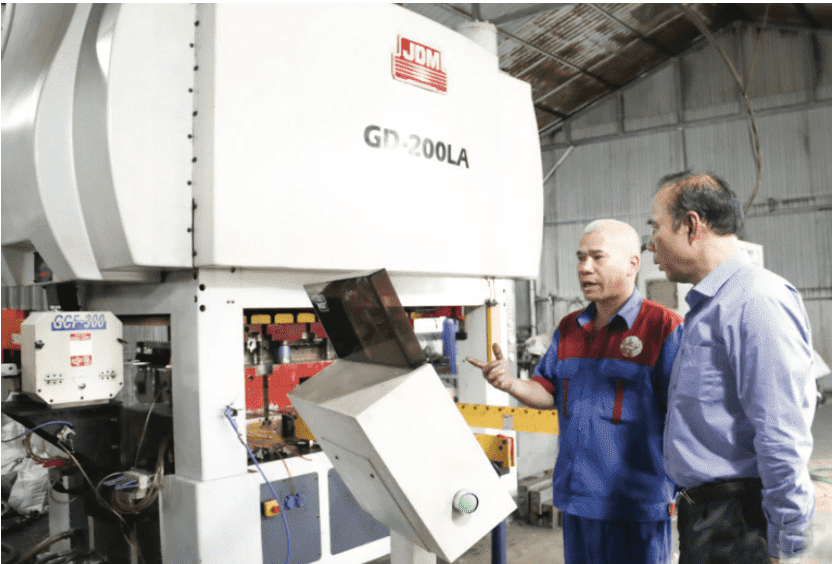
Decree No. 235 promotes digital transformation in the rural industrial sector.
Third, it will boost RISEP through comprehensive support from promotion to market expansion, facilitating access to international markets. Particular attention will be given to supporting the development of products after recognition at various levels. It will also encourage enterprise development, attract investment in rural production and business activities, and promote a strategic, systematic approach to investment in machinery, technology, and management to improve productivity, quality, and product value, while leveraging preferential treatment under free trade agreements to orient production toward export markets.
Fourth, it will consolidate and reorganize the industrial promotion system in line with Party guidelines and state policies, closely aligned with the requirements of the Industry and Trade sector. It will create favorable working and living conditions for public officials and employees engaged in industrial promotion, enabling them to perform effectively and maximize their capabilities. Commune-level officials will be encouraged to uphold responsibility, coordinate surveys, develop and implement industrial promotion projects at the grassroots level, and actively participate in the selection of outstanding rural industrial products.
More importantly, when small and micro enterprises in rural areas are activated, a strong spillover effect will emerge: increasing labor productivity, creating jobs, raising incomes, and directly contributing to local economic growth.
Thank you very much.
| With its comprehensive and flexible approach, Decree No. 235/2025/ND-CP is expected to become a key driver enabling localities to achieve high growth targets, while contributing to rapid and sustainable economic development in the new phase. |

