


E10 biofuel gasoline: Implementing a major Party and State policy
From 00:00 on June 1, 2026, E10 gasoline will officially be introduced nationwide, making Vietnam one of more than 60 countries using biofuel-blended gasoline.
Behind this milestone lies a consistent policy pursued by the Party and the State for more than a decade on green energy transition and safeguarding national energy security, a major policy requiring unified action across the entire political system and society.
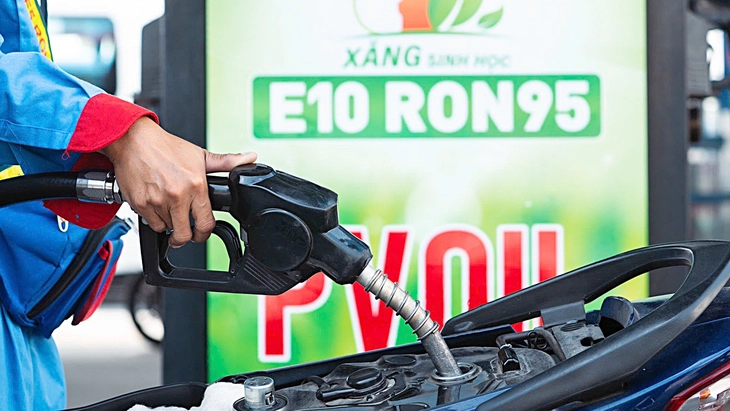
Having been proven worldwide for more than half a century, the biofuel transition is now a global trend. With nearly half a decade of preparation, Vietnam is not standing outside that trajectory.
A civilised trend proven over half a century
The story of biofuels began with the 1973 global oil crisis triggered by the Organization of Arab Petroleum Exporting Countries (OAPEC), which drove energy prices to unprecedented levels. At the time, Brazil depended on imports for 77.3% of its oil demand and was compelled to seek alternative energy sources to ensure energy security. On November 14, 1975, President Ernesto Geisel signed a decree establishing the Proálcool Programme, aiming to produce 3.5 billion litres of ethanol from sugarcane for gasoline blending. The programme helped improve the country's trade balance and environmental performance, laying the technological foundation for modern generations of biofuels.
Half a century later, according to the US Energy Information Administration (EIA) and the European Renewable Ethanol Association (ePURE), more than 60 countries have adopted E10 gasoline. Brazil has gone further, implementing blending rates ranging from E18 to E27.5. The European Union, together with the UK, achieved for the first time in 2023 its target of reducing greenhouse gas emission intensity in transport by 6.3%, largely thanks to biofuels. China, the world's largest automobile market, announced a nationwide E10 plan in 2017 and has now implemented it in 15 of its 31 provincial-level administrative units.
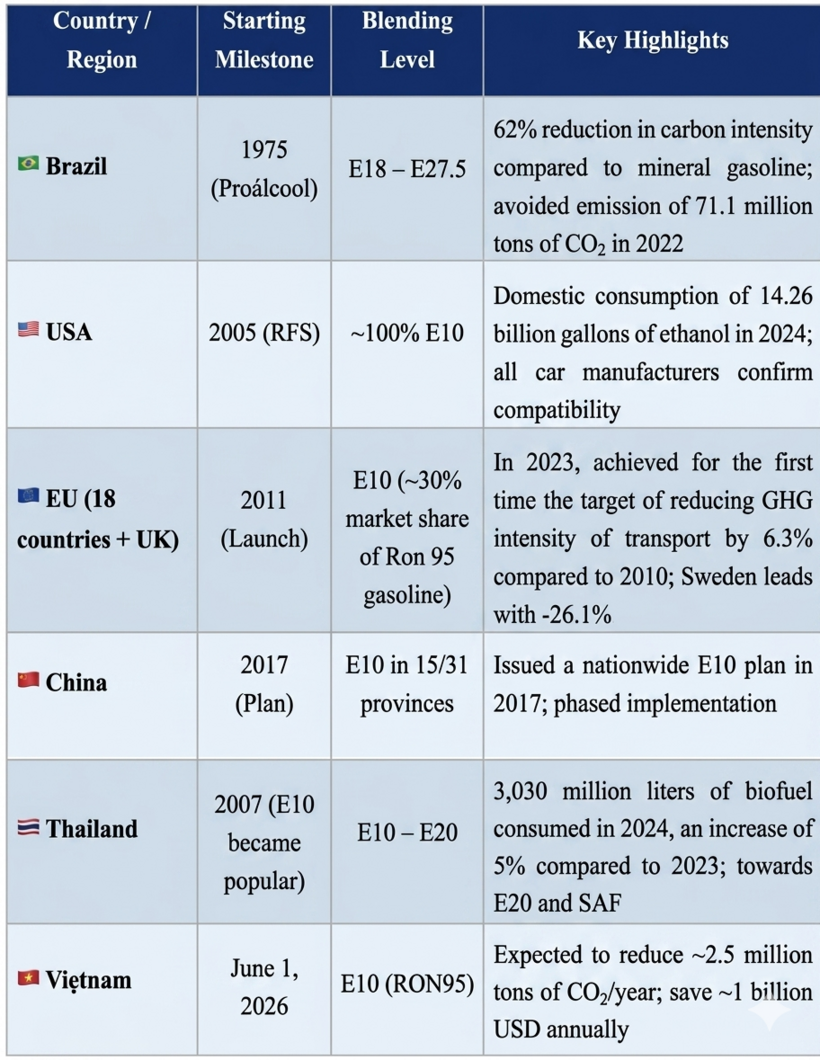
Table 1: Global adoption of biofuel gasoline
These figures demonstrate that biofuel gasoline is neither an experiment nor a temporary solution. Rather, it is an inevitable civilised trend that has been tested and validated over the past 50 years. Vietnam's adoption of E10 represents a step toward aligning with the mainstream global trend and standing alongside developed economies in the transition toward green energy.
Firmly safeguarding national energy security serves as a foundation and a crucial prerequisite for the country's development, while remaining an integral part of overall national security.
Vietnam's biofuel journey
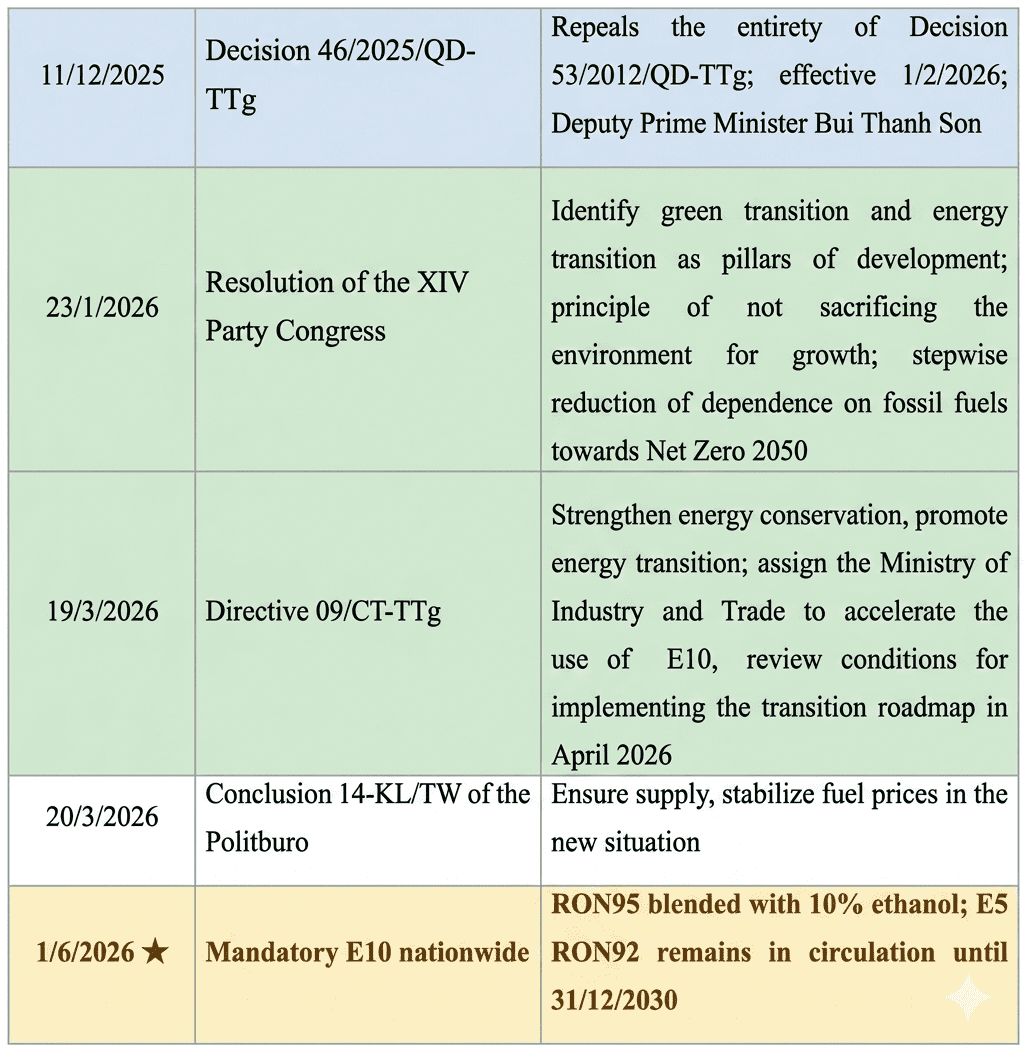
The decision to shift the entire market to E10, including ending the sale of RON95 mineral gasoline from June 1, 2026, is the practical implementation of a continuous political and legal direction reflected in Party Congress documents, Politburo resolutions, and legal instruments issued by the Government and the Ministry of Industry and Trade.
Biofuels are not a matter of choice, nor are they solely the responsibility of the Ministry of Industry and Trade. They are an inevitable response to Vietnam's realities and global trends, as well as a strategic imperative for national energy independence and energy security.
The documents of the 13th National Party Congress, adopted in January 2021, introduced for the first time the concepts of the circular economy, green economy and environmentally friendly development into official Party documents. They set the orientation for the 2021-2030 period to build a circular economy, "harmoniously balancing economic development and environmental protection," while establishing the roadmap, mechanisms and legal framework for the circular economy model.
Shortly after the Congress, at COP26 in November 2021, Vietnam committed to achieving net-zero emissions by 2050, laying the foundation for subsequent policies aimed at greening the transport sector.
Politburo Resolution No. 55-NQ/TW dated February 11, 2020, on the orientation of Vietnam's national energy development strategy to 2030 with a vision to 2045, serves as a fundamental political basis. It identifies diversification of energy sources and reduced dependence on fossil fuels as long-term requirements, with biofuels recognised as one of the key solutions.
The resolution sets quantitative targets, including increasing renewable energy's share in total primary energy supply to 15-20% by 2030 and 25-30% by 2045, while achieving energy savings of around 7% by 2030 compared with the business-as-usual scenario.
Politburo Resolution No. 70-NQ/TW dated August 20, 2025, on ensuring national energy security through 2030 with a vision to 2045, further upgraded and updated Resolution No. 55 in light of new circumstances. It raised the renewable energy target to 25-30% of total primary energy supply by 2030, compared with the previous target of 15-20%, representing a significant acceleration. It also set goals of achieving energy savings of 8-10% compared with the baseline scenario, reducing greenhouse gas emissions from energy activities by 15-35%, ensuring total primary energy supply of 150-170 million TOE, and generating 560-624 billion kWh of electricity.
Resolution No. 55-NQ/TW and Resolution No. 70-NQ/TW provide the direct policy basis for the transition to biofuel gasoline. Increasing the use of biofuels will help reduce dependence on imported fossil fuels and diversify energy supplies.
Specifically, Resolution No. 55-NQ/TW targets renewable energy accounting for 15-20% of total primary energy supply by 2030 and 25-30% by 2045.
Resolution No. 70-NQ/TW calls for the synchronous, balanced and diversified development of all forms of energy. It prioritises the effective exploitation and utilisation of renewable energy, new energy and clean energy sources; outlines plans for coal-fired power plants to switch to natural gas, biomass fuels, hydrogen and ammonia; and promotes the widespread adoption of circular economy models that utilise industrial by-products as energy inputs.
For the first time, the documents of the 14th National Party Congress identified environmental protection as a pillar, condition and driving force for rapid and sustainable development. They reaffirmed the principle of not sacrificing the environment for economic growth, established a new growth model based on science and technology, innovation, digital transformation and green transition, and promoted the circular economy and energy transition while gradually reducing dependence on fossil fuels toward achieving net-zero emissions by 2050.
Decision No. 1658/QD-TTg dated October 1, 2021, approving the National Green Growth Strategy for the 2021-2030 period with a vision to 2040, sets out numerous specific targets aimed at transforming the growth model toward greener and lower-emission development. Key targets include reducing greenhouse gas emission intensity per unit of GDP by at least 15% by 2030 compared with 2014 levels, and by at least 30% by 2050.
Decision No. 215/QD-TTg dated March 1, 2024, approving Vietnam's National Energy Development Strategy to 2030 with a vision to 2045, establishes the overarching objective of firmly ensuring national energy security while meeting socio-economic development requirements and promoting energy transition. In other words, these Government decisions all pursue the development of renewable energy, green energy and reduced CO2 emissions.
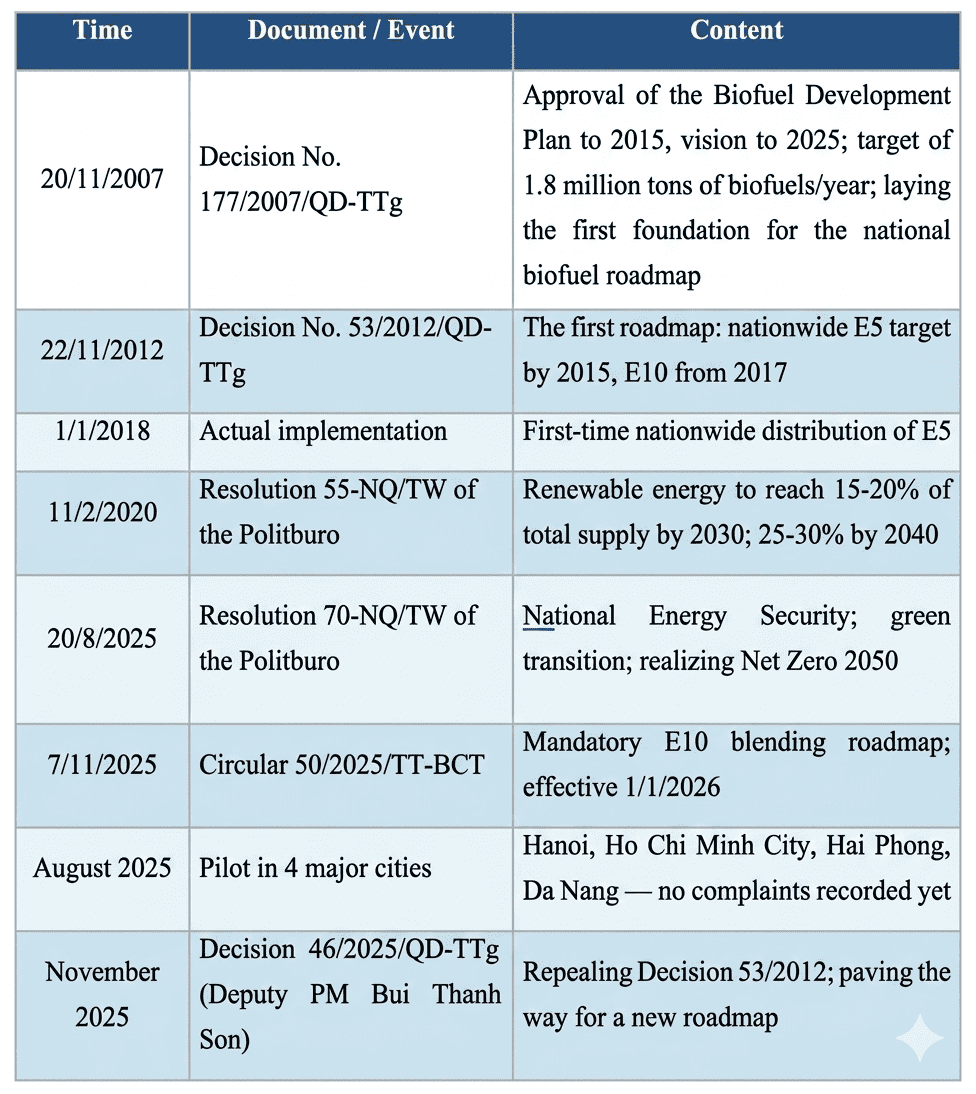
However, the story began decades earlier. Decision No. 53/2012/QD-TTg dated November 22, 2012, issued by the Prime Minister on the roadmap for blending biofuels with traditional fuels, stipulated that following the pilot phase, all gasoline produced, blended and sold nationwide for road transport vehicles from December 1, 2015, would be E5 gasoline. From December 1, 2017, gasoline produced, blended and marketed nationwide for road transport vehicles was also scheduled to follow the biofuel roadmap.
June 1, 2026, therefore marks the convergence of a consistent policy trajectory spanning from 2012 to 2026, from the 13th National Party Congress and its emphasis on the circular economy, to Resolution No. 55-NQ/TW on energy strategy and biofuels, followed by the COP26 net-zero commitment, then Resolution No. 70-NQ/TW on energy security and higher renewable energy targets, and subsequently the 14th National Party Congress, which identified green transition as a key pillar of development. It is not a sudden decision.
Vietnam's biofuel journey officially began with Decision No. 177/2007/QD-TTg on the biofuel development scheme through 2015 with a vision to 2025, targeting annual production of 1.8 million tonnes of biofuels. This was followed by Decision No. 53/2012/QD-TTg, which established a detailed roadmap: nationwide E5 RON92 from 2014-2015 and E10 from 2017.
E5 RON92: From pilot programme to mandatory implementation
Reality differed considerably from the original plan. Following pilot implementation in seven localities in December 2014, Hanoi, Hai Phong, Quang Ngai, Da Nang, Ho Chi Minh City, Ba Ria-Vung Tau and Can Tho, E5 rollout was repeatedly postponed from 2015 to 2016, then to mid-2017, before finally becoming mandatory nationwide on January 1, 2018, three years behind schedule. E10, originally planned for introduction in 2017, was delayed by nearly nine years.
At one point, E5 RON92 accounted for approximately 42% of total gasoline consumption nationwide, while RON95 represented around 58%. However, its market share subsequently declined dramatically over the following six years.
Four reasons behind E5's underperformance
First, the price difference was not attractive enough. Environmental protection tax on E5 remained high at VND 3,800 per litre, equivalent to roughly 95% of the tax imposed on RON92 mineral gasoline. As a result, E5 was only around VND 800-1,200 per litre cheaper than RON95, a margin too small to influence consumer behaviour.
Second, the RON92 gasoline base had relatively low quality, which became a critical weakness. Most modern vehicles are recommended to use gasoline with an octane rating of 95 or higher. Many users reported engines running hotter, consuming more fuel and delivering weaker performance.
Third, public concerns that "E5 damages engines and increases fuel consumption" spread widely without timely scientific clarification, while communication efforts remained insufficiently proactive.
Fourth, the continued parallel sale of RON95 made the transition more difficult to promote. Additional factors included the sharp decline in global oil prices, which reduced ethanol's competitiveness, and the US-China trade tensions during 2019-2020, which disrupted supply stability.
A consistent thread running from Resolution No. 55 to Resolution No. 70
Vietnam is not outside the global trend. In 2012, the Prime Minister issued Decision No. 53/2012/QD-TTg, the first legal document laying the foundation for the national biofuel roadmap, targeting nationwide E5 gasoline by 2015 and E10 by 2017. Although the roadmap was delayed, the political determination never changed. E5 gasoline was distributed nationwide from January 1, 2018, creating the foundation for the next stage. More importantly, this orientation was elevated by the Party into a strategic policy through a series of interconnected documents, each containing specific provisions relating to petroleum products and biofuels.
At the national conference held on September 16, 2025, to disseminate and implement four Politburo resolutions, Party General Secretary To Lam stated clearly: “The core objective is to ensure that the energy system remains safe and stable, while creating breakthroughs in the strategy for safeguarding energy security, promoting sustainable development and realising the Net Zero commitment by 2050.” The General Secretary also stressed that “stable and green energy is a prerequisite for production, schools and hospitals.”
On March 20, 2026, the Politburo issued Conclusion No. 14-KL/TW on ensuring fuel supply and stabilising fuel prices under new circumstances. The conclusion assigned the Standing Committee of the Government Party Committee to proactively develop response scenarios for fluctuations in global petroleum prices and to promptly formulate a long-term national strategy on the supply and storage of raw materials and fuels. This further demonstrates that fuel self-sufficiency, including biofuels, remains a consistent priority in the Party and State leadership's policy direction.
A notable feature of this roadmap is its multi-layered legal structure. Party resolutions provide strategic orientation; decisions issued by the Prime Minister establish the legal framework; circulars issued by the Ministry of Industry and Trade prescribe technical requirements; and pilot programmes are conducted to verify effectiveness before broader deployment. Since August 2025, E10 gasoline has been piloted in Hanoi, Ho Chi Minh City, Hai Phong and Da Nang, with no officially recorded complaints to date regarding fuel quality or impacts on vehicle engines.
For national energy security
One of the most fundamental reasons for implementing E10 is to strengthen national energy security. Vietnam currently imports a significant share of its petroleum products and remains directly exposed to fluctuations in international markets. Replacing 10% of gasoline consumption with domestically produced ethanol would correspondingly reduce import expenditure, generating estimated foreign currency savings of nearly USD 1 billion annually.
At a time when global energy geopolitics remains highly volatile, the Politburo meeting on March 20, 2026, specifically discussed measures to respond to petroleum price fluctuations arising from developments in the Middle East. Under such circumstances, greater domestic fuel self-reliance has become a matter of national security.
The ethanol used for E10 is produced from cassava, corn and sugarcane, crops widely cultivated across Vietnam. This creates a closed economic cycle in which domestic agriculture supplies raw materials, processing industries produce ethanol, and fuel is consumed domestically rather than requiring foreign currency outflows for imports.
Dual benefits: A cleaner environment and better livelihoods for farmers
From an environmental perspective, ethanol in E10 enables cleaner and more complete combustion, reducing harmful emissions such as CO, HC, SOx and NOx, which are among the major contributors to urban air pollution. According to calculations by various experts, nationwide deployment of E10 could reduce carbon dioxide equivalent emissions by approximately 2.5 million tonnes annually, making a direct contribution to the carbon neutrality commitment announced by the Prime Minister at COP26.
For comparison, Brazil has achieved annual emission reductions of 71.1 million tonnes of CO2, while the European Union reduced transport greenhouse gas intensity by 6.3% over a 13-year period. Given that Vietnam ranks among the fastest-growing fuel consumption markets in Southeast Asia, a reduction of 2.5 million tonnes of CO2 equivalent would represent a meaningful contribution.
For agriculture, each ethanol plant in operation provides a stable market for the produce of around 15,000 cassava-growing households in upland areas. Expanding ethanol production will create sustainable demand for cassava, corn and sugarcane, key crops for farmers in midland and mountainous regions where stable market outlets are often most limited. This represents a direct channel through which energy policy can support rural incomes without requiring separate subsidy mechanisms.
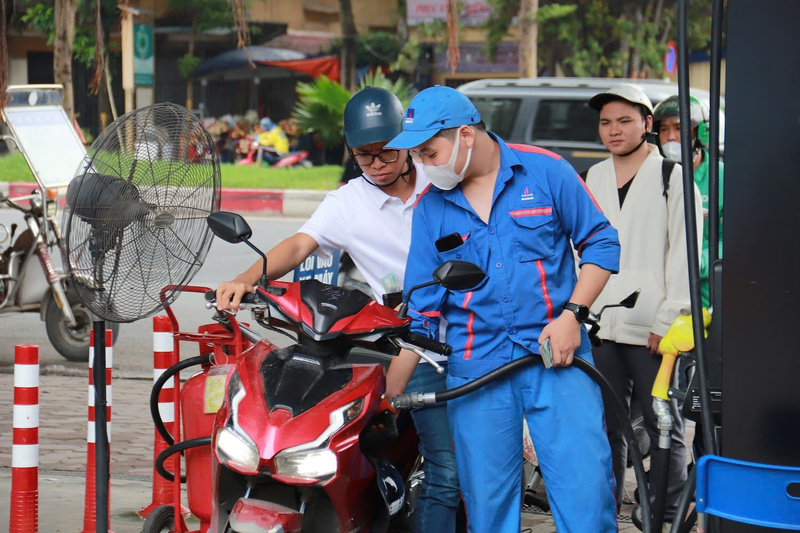
The implementation of biofuel gasoline is not an imposed decision. Rather, it stems from the requirements of sustainable development, energy security, environmental protection and the fulfilment of Vietnam’s international commitments.
A major policy requiring unity across the political system and society
The policy orientations and chain of documents issued over more than a decade clearly demonstrate one fact: the implementation of E10 is not merely an internal matter for the Ministry of Industry and Trade. It is a practical step in implementing the Party's policy, a major policy of the Party and the State that requires coordinated participation across the entire political system and broad public consensus.
Government ministries and sectors formulate and implement policies; local authorities develop distribution infrastructure; media organisations help shape public awareness; and above all, every citizen and every consumer plays a decisive role in determining success through each fuel purchase.
Nguyen Sinh Nhat Tan, Deputy Minister of Industry and Trade, affirmed: "The implementation of biofuel gasoline is not an imposed decision. It stems from the requirements of sustainable development, energy security, environmental protection and the fulfilment of Vietnam's international commitments.''
International experience shows that no country has successfully developed biofuel programmes through the efforts of a single sector alone. Brazil's Proálcool Programme succeeded thanks to close coordination among the agricultural, industrial, financial and communication sectors over several decades. The US achieved nearly universal E10 adoption after Congress passed the Energy Policy Act of 2005 and established the Renewable Fuel Standard (RFS), while businesses invested in infrastructure and consumers accepted the fuel naturally because they perceived no difference when refuelling.
Experts share a common assessment: the policies are already in place and the Party and State's strategic direction is clear. The greatest challenge facing Vietnam lies in consumer perceptions. Therefore, communication efforts must move one step ahead, delivering information accurately, comprehensively and effectively to meet public demand in a timely manner.
In Vietnam, June 1, 2026, does not mark the beginning of E10 gasoline. Rather, it marks the start of a new chapter in the country's biofuel story after a journey spanning more than a decade since Decision No. 53/2012/QD-TTg. The policy direction has remained consistent through Resolution No. 55-NQ/TW, Resolution No. 70-NQ/TW and Politburo Conclusion No. 14-KL/TW. The legal foundation is in place, and international experience is readily available. What remains is the consensus and action of the entire political system and every citizen.
| Each tank of E10 purchased by consumers represents a vote for national energy security, for cleaner skies for future generations, and for Vietnam's aspiration to stand alongside advanced nations in the country's new era of development. When the entire nation shares a common determination, the Party's green policy will be transformed into green realities on roads across the country, beginning with the simplest of actions: every time we refuel. |

