


Ministry of Industry and Trade consults on draft fund to promote economical and efficient use of energy
On the morning of August 13, 2026, in Da Nang City, the Agency for Innovation, Green Transition and Industry Promotion (IGIP), under the Ministry of Industry and Trade (MoIT), held a workshop to consult on the draft establishment of a Fund for Promoting Economical and Efficient Use of Energy.
Promoting economical and efficient use of energy
Speaking at the opening of the workshop, Nguyen Thi Lam Giang, Director of IGIP under MoIT, said that over the past years the National Energy Efficiency Program (VNEEP) has been widely implemented nationwide, helping raise awareness, build capacity and promote the application of energy-saving and efficiency solutions across sectors and fields.
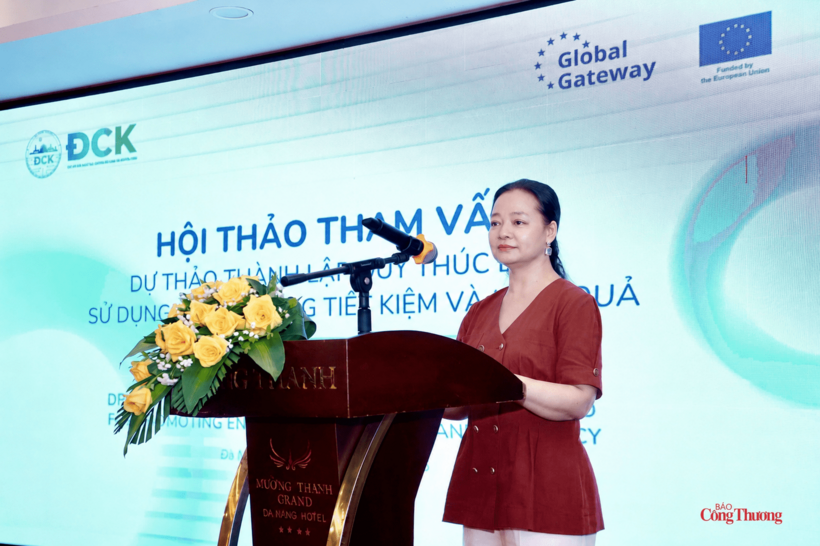
Nguyen Thi Lam Giang, Director of IGIP under MoIT, delivers remarks at the event.
According to Nguyen Thi Lam Giang, the economical and efficient use of energy is not only a solution that helps ensure national energy security but also brings direct benefits to businesses by cutting production costs and improving energy efficiency, productivity and competitiveness.
The potential for energy savings in industry, construction, trade and many other sectors of the economy remains substantial. Many businesses have proactively upgraded production lines, replaced low-efficiency equipment, optimized systems and invested in new technology. However, one of the biggest bottlenecks remains capital and access to finance.
For this reason, designing and building the Fund for Promoting Economical and Efficient Use of Energy is of major significance. The fund is designed as a financial tool to mobilize and connect resources from the State, the private sector, financial institutions and development partners for the economical and efficient use of energy.
In addition, the fund could also connect technical and international resources to support businesses in energy audits, project preparation, workforce training and technology transfer. Its value lies not only in providing an additional source of capital but also in creating an ecosystem that supports businesses, from identifying potential and preparing projects to technical assistance, capital mobilization, investment implementation and achieving energy-saving results.
"For the Fund for Promoting Economical and Efficient Use of Energy to truly work effectively, we need to discuss together its organizational and operating model, capital sources and management mechanism, financial tools, as well as the conditions and procedures for businesses to access the fund's resources conveniently, transparently and effectively," Nguyen Thi Lam Giang said.
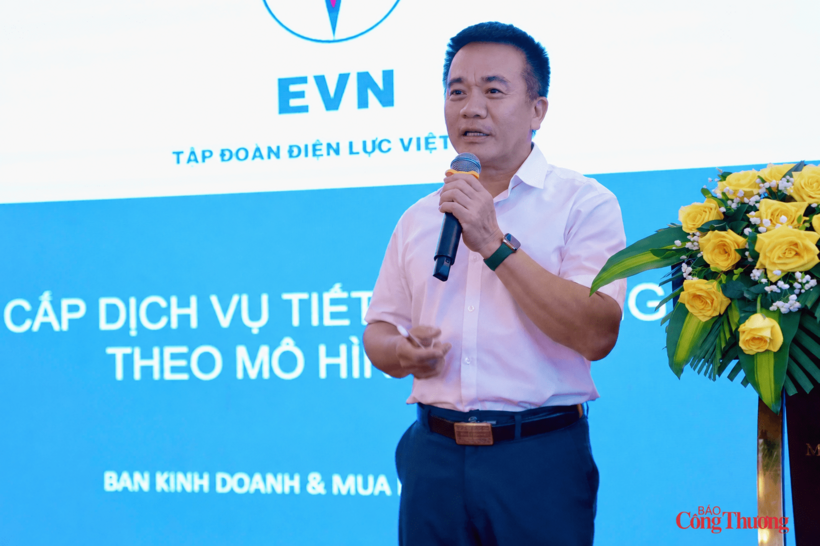
Tran Viet Nguyen, Deputy Head of the Business Department, Vietnam Electricity (EVN), shares experience in implementing the ESCO model.
Drawing on international experience and lessons from Vietnam
Tran Thuy Duong, Director of the Vietnam - EU Sustainable Energy Transition Program (SETP) and representative of the Delegation of the European Union to Vietnam, said the workshop was part of a study conducted under a technical assistance package aimed at providing recommendations to help IGIP develop a model for the energy-saving fund. The study examined international experience, particularly from EU countries, as well as lessons from related funds in Vietnam.
"The workshop is an opportunity to discuss specific issues raised in the study: the fund's model, organization, operating mechanism, financial sources, forms of support and roadmap for establishment," Tran Thuy Duong said.
At the workshop, Pham Phan Dung, a member of the research team, shared international experience in implementing funds to promote the economical and efficient use of energy, including experience from similar funds in Vietnam.
According to a review of international experience across 10 countries, there are 16 funds, classified into five business-model groups: direct financial fund models, non-repayable grant fund models, financial intermediary and risk-sharing models, market-obligation-based policy models, and combined fund models. Of these, the most successful models combine multiple financial tools with technical cooperation mechanisms and project quality control.
In Vietnam, there are four types of funds: direct public finance funds, development investment funds, green investment funds and local development investment funds.
On the direction for establishing the Fund for Promoting Economical and Efficient Use of Energy, Dung said five factors should be prioritized. First, the fund needs to be defined as a policy financial tool that catalyzes the market rather than replacing commercial financing channels, with a focus on risk-sharing. Second, the fund should be designed as a multi-instrument financial model that flexibly combines forms of support such as preferential loans. Third, the establishment and operation of the fund must be linked to the existing financial and banking system. Fourth, the fund should be integrated into the overall policy framework on energy transition, green growth and the implementation of Vietnam's international commitments, such as the net-zero emissions target, the Just Energy Transition Partnership (JETP) and the development of a carbon market. Fifth, the fund's governance model must ensure relative independence, professionalism, transparency and an effective oversight mechanism, while clearly distinguishing the function of energy management from that of managing and operating the fund.
Sharing experience in managing entrusted lending from BIDV's funds and projects, Dinh Huong Thuy, Deputy Director of the Financial Institutions Department at BIDV, said the bank has experience implementing projects that carry no credit risk as well as projects that do, and in operating as an entrusted bank managing capital from the Government and donors.
On its experience serving domestic funds, Thuy said BIDV is a bank chosen by many ministries, sectors and state agencies to help implement off-budget financial funds, including the Vietnam Environment Protection Fund, the Small and Medium Enterprise Development Fund, the National Foundation for Science and Technology Development, the National Technology Innovation Fund and the National Data Development Fund.
For the Fund for Promoting Economical and Efficient Use of Energy, BIDV plans to serve as the bank entrusted with lending, receiving and deploying the fund's entrusted capital, while also acting as the fund's service bank, providing account infrastructure and integrated banking services.
At the workshop, Tran Viet Nguyen, Deputy Head of the Business Department at Vietnam Electricity (EVN), shared experience in implementing energy-saving investment projects under the ESCO model. According to Nguyen, EVN's ESCO operating model is based on energy-saving project performance contracts, including guaranteed-savings contracts and shared-savings contracts.
EVN recommended forming a financial fund to promote the economical and efficient use of energy; standardizing measurement and verification procedures; conducting independent assessment and publishing a list of qualified ESCOs; issuing accounting guidance for units using state budget funds; and promoting the activities of the Vietnam ESCO Association.
| According to a representative of IGIP, the input gathered at the workshop will serve as a basis for MoIT to further refine the model for the Fund for Promoting Economical and Efficient Use of Energy, ensuring its feasibility, effectiveness, transparency and sustainability. |

