


75 years of Vietnam’s industry: Building internal strength and elevating national stature
After 75 years of development, Vietnam’s industrial sector has achieved major milestones, becoming a key driver of economic growth while gradually affirming the country’s position in global value chains.
Industrial competitiveness has improved significantly
Vietnam has risen to become one of the countries with an upper-middle level of global industrial competitiveness. The country’s industrial competitiveness ranking climbed 16 places over a decade, from 58th in 2009 to 42nd in 2019, according to the United Nations Industrial Development Organization (UNIDO). Vietnam also recorded the fastest improvement among ASEAN countries, approaching fifth place in the region, trailing only the Philippines by 0.0015 points and moving closer to the four strongest industrial economies in ASEAN.
During the 2011 - 2020 strategic development period, industry posted the highest growth rate among all economic sectors, contributing nearly 30% to GDP and becoming the country’s leading export sector. This helped Vietnam rise from 50th place in 2010 to 22nd in 2019 among the world’s largest exporting nations.
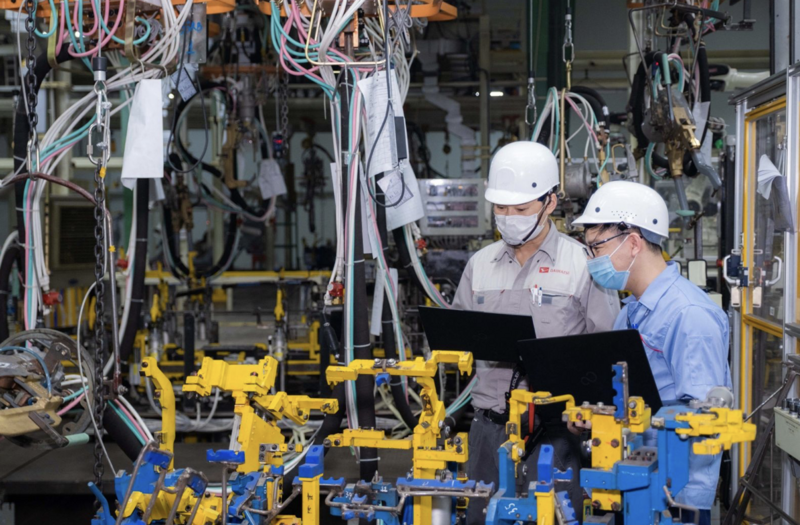
The processing and manufacturing industry has become the main growth engine of the industrial sector. Photo: VNA
To date, Vietnam has developed several key industrial sectors that form the backbone of the economy, including oil and gas extraction and processing; electronics, telecommunications and information technology; metallurgy and steel production; cement and construction materials; textiles and garments; leather and footwear; mechanical engineering, manufacturing, automobiles and motorcycles. These sectors have laid an important foundation for long-term growth while accelerating the country’s modernization and industrialization process.
At the same time, industrial restructuring associated with growth model transformation and productivity improvement has increasingly moved toward the core of industrialization. The internal structure of the industrial sector has shifted positively. The share of mining industries in GDP continuously declined, from 9.1% in 2010 to around 8.1% in 2016 and only 5.55% in 2020.
The processing and manufacturing industry has become the principal growth driver of the industrial sector. In 2020, processing and manufacturing played a decisive role in driving economic growth, expanding by 5.82%. Throughout the 2011–2020 period, the sector continuously expanded and maintained the largest share among industrial industries, with its contribution to GDP rising steadily from 13% in 2010 to 14.27% in 2016, 16.48% in 2019 and approximately 16.7% in 2020.
Supporting industries have also received increasing attention, particularly in Vietnam’s major production sectors such as textiles and garments, leather and footwear, electronics and agro-processing. Initial industrial support ecosystems have gradually taken shape, contributing to higher localization rates.
Product structure shifts in a positive direction
According to the Ministry of Industry and Trade, Vietnam’s product structure has undergone a positive transformation, with the share of medium- and high-technology products increasing significantly. This has created the basis for the emergence of several large private industrial corporations capable of competing internationally. The proportion of processed exports in total export value increased from 65% in 2016 to 85% in 2020, while the share of high-tech exports rose from 44.3% in 2016 to 49.8% in 2020.
One notable milestone was UNIDO’s classification of Vietnam from the group of “developing economies” to the group of “emerging industrial economies,” reflecting substantial improvements in industrial competitiveness.
Importantly, industry has become the sector contributing the largest share to the state budget, accounting for more than 90% of the country’s total export turnover, while playing an active role in job creation, labor restructuring, productivity enhancement and improving people’s living standards.
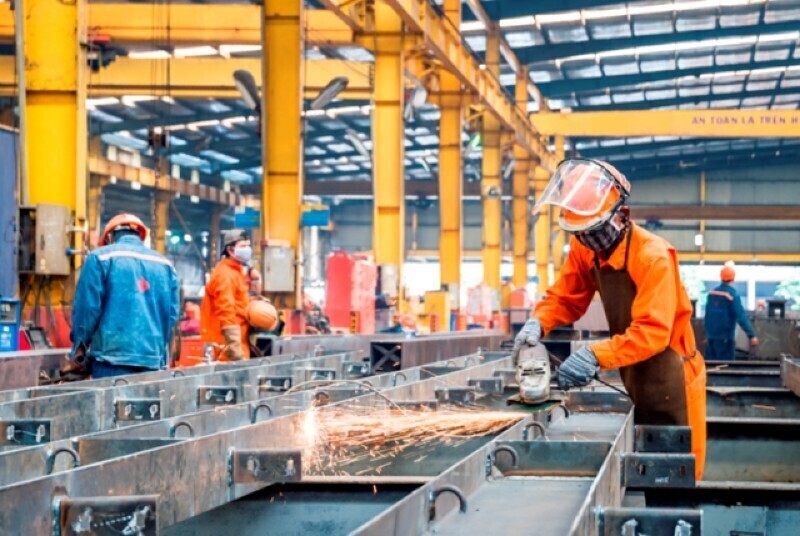
Industry has become the sector making the largest contribution to the state budget and accounting for more than 90% of Vietnam’s total export turnover. Photo: VNA
The industrial structure has shifted in a more positive direction, gradually reducing the proportion of resource-intensive and low-technology industries while increasing the share of medium- and high-technology sectors. The contribution of processing and manufacturing to GDP rose from 13% in 2010 to 16.7% in 2020. Vietnam has also witnessed the formation and development of several major private industrial groups with the potential to expand into regional and international markets.
Notably, processing and manufacturing has remained the decisive factor determining industrial growth, generating the largest added value within the industrial sector and serving as the main engine of Vietnam’s economic growth over many years. Together with the country’s broader achievements in socio-economic development, the sector has fulfilled its role as the “backbone” of the economy. In 2025, with its share reaching 24.7% of GDP, processing and manufacturing strongly affirmed its strategic role in Vietnam’s journey toward becoming a sustainably developed industrialized nation.
In an interview with the Newspaper of Industry and Trade, Dr. Tran Van Khai, Vice Chairman of the National Assembly’s Committee for Science, Technology and Environment, said that several processing and manufacturing industries are emerging as sectors with clear competitive advantages that Vietnam should prioritize to create breakthroughs.
He cited Vietnam’s automobile industry as a notable example. In 2025, automobile output surged by 39.1%, marking an exceptional acceleration. The rise of Vietnamese enterprises such as VinFast, along with joint ventures including Thaco and Hyundai Thanh Cong, demonstrates that Vietnam is gradually establishing competitive advantages in both the domestic market and export potential.
Prioritizing foundational industries toward long-term development goals
According to experts and policymakers, enhancing industrial development and improving competitiveness in the global market require a synchronized and unified system of solutions and policies, from theory to practice, in order to mobilize resources and maximize the strengths of Vietnam’s industrial sectors.
More fundamentally, to build a truly developed industrial sector capable of playing a central role in economic growth, the Ministry of Industry and Trade believes Vietnam needs a new mindset and approach toward industrialization and modernization policies in the context of the new development stage toward 2030, with a vision to 2045.
Under this orientation, industrialization and modernization policies should prioritize the development of foundational industries while promoting balanced and rational growth of spearhead industries and emerging sectors, based on science and technology, innovation and technologies associated with the Fourth Industrial Revolution.
At the same time, industrialization and modernization policies should gradually expand beyond traditional mechanisms such as tax incentives and preferential credit toward new policy instruments, including direct budgetary support. Vietnam also needs to establish criteria, mechanisms and conditions to identify and develop large-scale industrial clusters, supporting industry zones and specialized industrial parks for foundational industries, based on industrial concentration and supply chain connectivity. This would help form comprehensive industrial ecosystems capable of generating spillover effects for related industries.
In addition, Vietnam must focus on creating new growth drivers for the industrial sector under the principle of sustainable development. Strengthening resilience and moving toward greater self-reliance by mastering high value-added stages in global production chains, while preserving natural resources and protecting the environment, will be crucial factors enabling Vietnam’s industry to overcome existing challenges and continue serving as a leading force for national economic development.
In an interview with the Newspaper of Industry and Trade, Tran Viet Hoa, Director of the Agency for Industry under the Ministry of Industry and Trade, stressed that the ministry will focus its industrial development policies on foundational and priority industrial sectors.
The ministry will also propose that the Government develop large-scale industrial parks and industrial clusters to attract investment and establish industrial production chains. At the same time, Vietnam needs policies to build large corporations capable of leading industrial sectors forward. Alongside the development of foundational industries, Vietnam must continue promoting sectors that provide input materials for other industries, including autonomous industries, mechanical engineering, chemicals and materials industries.
On April 3, 2026, the Government issued Resolution No. 82/NQ-CP approving policies under the Law on Key Industries, including two policies proposed by the Ministry of Industry and Trade: encouraging domestic production and manufacturing of key industrial products, and developing supporting industries.
| The resolution is considered an important step toward improving the legal framework and promoting the transition of Vietnam’s industry from extensive growth to intensive development, from processing and assembly toward research, design and production with higher technological content and added value. It is expected to create a solid foundation for enhancing the self-reliance and competitiveness of Vietnam’s industrial sector in the coming period. |

