


Ministry of Industry and Trade holds conference to discuss solutions to reduce logistics costs and boost exports
On the morning of September 22 in Hanoi, the Ministry of Industry and Trade held a conference to discuss solutions to reduce logistics costs and boost exports. The conference was attended by representatives of the Ministries of Industry and Trade, Finance, Construction, and Public Security, units under the Ministry of Industry and Trade, as well as industry associations and logistics associations.
Businesses face difficulties due to high costs
In his opening remarks, Tran Thanh Hai, Deputy Director of the Agency of Foreign Trade under the Ministry of Industry and Trade, emphasized that import and export activities continued to be a bright spot of the economy, playing an important role and serving as one of the drivers of macroeconomic growth. However, as trade volumes continue to expand, the need to reduce costs, particularly logistics costs, has become increasingly urgent.
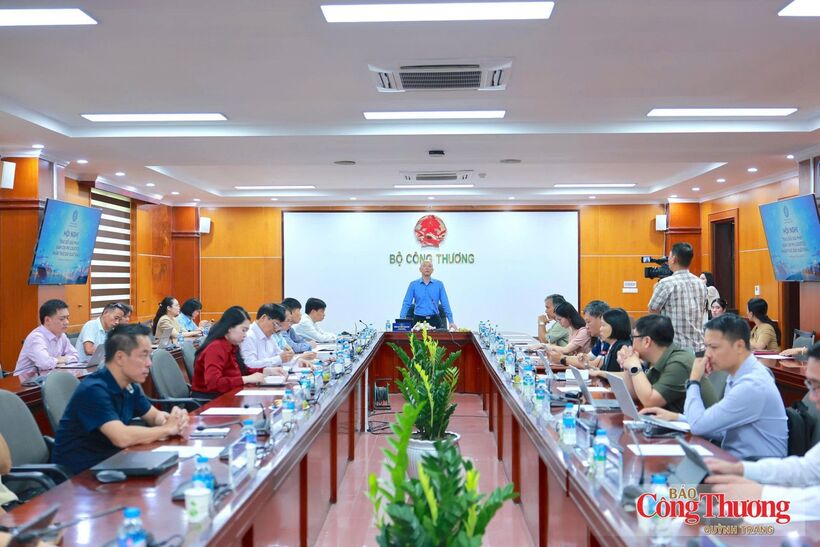
The conference discusses solutions to reduce logistics costs and boost exports
The conference was held to implement the direction of Standing Deputy Prime Minister Pham Gia Tuc under Notice No. 443/TB-VPCP dated August 20, 2026, issued by the Office of the Government on implementing solutions to support businesses and boost exports.
According to Tran Thanh Hai, the conference was organized to directly hear the difficulties and obstacles faced by industry and logistics associations, while strengthening dialogue among businesses, entities in the transport and logistics chains, seaports, and State management agencies to clearly identify bottlenecks and appropriate solutions.
Bui Ba Nghiem, a senior expert at the Agency of Foreign Trade, said that in 2025, Vietnam's total merchandise import and export turnover reached USD 930.1 billion, up 18.2% from 2024, while the trade surplus stood at USD 20.05 billion.
In the first eight months of 2026, total import and export turnover reached USD 770.14 billion, up 28.7%. Exports reached USD 374.84 billion, up 22.4%, while imports reached USD 395.30 billion, up 35.3%, resulting in a trade deficit of around USD 20.46 billion.
Notably, processed and manufactured industrial goods accounted for 90.17% of export turnover, while capital goods accounted for 94.11% of import turnover. The sharp rise in imports was largely associated with machinery, components, and raw materials serving production. This shows that demand for transportation, warehousing, and supply chain organization is continuing to grow.
Meanwhile, foreign-invested enterprises accounted for 80.1% of export turnover in the first eight months of the year, while the domestic economic sector recorded a trade deficit of around USD 30.60 billion. Therefore, optimizing logistics is not only aimed at facilitating the flow of goods but must also be linked to improving the capacity of domestic enterprises to participate in supply chains.
Logistics costs are also being viewed more broadly than transportation costs alone. The total cost of a shipment includes freight charges, port fees, warehousing, service fees, procedural and compliance costs, inventory and capital costs, as well as costs arising from delays, damage, insufficient information, or reprocessing.
According to the Viet Nam Logistics Report 2025, logistics costs are estimated to be equivalent to around 16-17% of GDP. However, this is an economy-wide indicator rather than a cost ratio applicable to every industry or enterprise. Differences in measurement methods also highlight the need to establish an official and stable data system and baseline at an early stage.
Against this backdrop, the Agency of Foreign Trade proposed building a national logistics cost measurement system, standardizing methodologies, data sources, and publication cycles, and monitoring costs by industry, corridor, and type of enterprise.
Alongside the overall indicator relative to GDP, it is necessary to monitor costs per tonne, container, or shipment; total transit time and waiting time; on-time delivery rates; inventory days; empty running rates; container and yard storage charges; electronic document rates; and the number of times data must be re-declared.



Representatives of several associations delivers remarks at the conference
Practical experience from different industries shows that each link in the chain can generate additional costs. Truong Van Cam, Vice Chairman and Secretary General of the Viet Nam Textile and Apparel Association, said that in 2025, the textile and apparel industry's total import and export turnover reached USD 71.6 billion, including USD 46.2 billion in exports and USD 25.5 billion in imports. For the textile and apparel industry, domestic logistics costs, from factories to ports, currently account for around 9-10%. Meanwhile, the industry has a profit margin of around 3-5%. Therefore, reducing logistics costs has a direct impact on business efficiency.
The Viet Nam Textile and Apparel Association proposed continuing to improve port operations and customs procedures, while expanding the list of enterprises eligible for the customs priority regime to include large-scale enterprises with stable operations and good compliance records. It also called for stronger rail, inland waterway, and maritime connectivity to reduce dependence on road transport.
For the food industry, a representative of the Viet Nam Food Association said that rice exports reached around 6 million tonnes in the first eight months, worth approximately USD 3 billion. Most rice production and mills are concentrated in the Mekong Delta, but the region still lacks specialized deep-water ports capable of serving large vessels, forcing businesses to transport goods to Ho Chi Minh City and thereby incurring additional costs.
Meanwhile, a representative of the Viet Nam Coconut Association said that warehousing and post-harvest handling also generate additional costs. The lack of fumigation and irradiation services in northern Vietnam means some enterprises have to transport goods to the south for processing, followed by warehousing, increasing costs and affecting storage time.
For seafood, a representative of the Viet Nam Association of Seafood Exporters and Producers (VASEP) said logistics costs also include cold storage, warehousing, containers, and additional expenses related to vessels and documentation. The association proposed establishing a database for determining container transport costs, with forecasts to help enterprises proactively calculate costs when signing contracts with partners, while accelerating the digitalization and interconnection of documentation procedures.
From the perspective of logistics enterprises, Nguyen Duy Minh, Vice Chairman of the Viet Nam Logistics Business Association, said logistics costs need to be viewed across multiple links, starting with customs clearance time. When goods are processed and cleared quickly, enterprises will have greater flexibility in organizing transportation and reducing costs.
The association also proposed selecting several transport corridors and industries for pilot implementation, clearly identifying the issues, relevant agencies, and types of costs incurred, and then developing specific solutions for each flow of goods.
Customs and transport reforms to reduce time and costs
At the conference, a representative of the Customs Department under the Ministry of Finance said customs procedure reform remained an important area for facilitating import and export activities.
The Customs sector is currently focusing on simplifying administrative procedures, promoting digitalization, and developing a digital customs scheme. In the first six months of the year, the sector reviewed and standardized 40 forms and 44 document templates used in customs documentation. Since July 2026, several software providers have developed solutions to support the conversion of paper documents into electronic data.


Representatives of ministries and sectors share their views
The goal is to implement the principle that data already provided by an enterprise should not be requested again. When data is digitalized and interconnected, management agencies can make more effective use of it, while enterprises can reduce the time and costs involved in carrying out procedures.
However, one of the current bottlenecks lies in the interconnection between customs procedures and specialized management procedures. Some permits, certificates, or inspection results still have to be submitted in original form. Some procedures have been implemented through the National Single Window but are not yet fully electronic, while others still operate on separate portals, resulting in incomplete data connectivity and interoperability.
Notably, according to the results of customs clearance time measurements conducted by independent agencies and the annual cargo release time measurements conducted by the Customs sector, around 70% of customs clearance time is still attributable to other procedures, such as obtaining permits, transportation, inspection, and testing. The time spent processing goods by customs authorities accounts for only part of the total time required for goods to be released.
This shows that reducing logistics costs requires coordination among multiple ministries, sectors, and localities, rather than focusing solely on customs procedures.
A representative of the Ministry of Construction said the ministry had implemented various solutions to facilitate transport activities and support import-export enterprises, including reforming and simplifying administrative procedures and reviewing and cutting business conditions in the transport sector.
Regarding procedures involving vessels, including cargo ships, procedures are gradually being carried out centrally through electronic systems. The Ministry of Construction has also implemented measures concerning the exemption, reduction, and simplification of certain procedures for inland waterway vessels.
At the same time, the ministry is focusing on completing the legal framework for the maritime and inland waterway sectors and developing transport policies, while collecting feedback from ministries, sectors, localities, and the business community.
From addressing individual bottlenecks to reorganizing the entire chain
According to the Agency of Foreign Trade, reducing logistics costs requires simultaneous implementation of multiple groups of solutions. First, transport should be reorganized along corridors and multimodal connectivity strengthened. At the same time, time and costs at seaports, airports, border gates, and warehouses should be reduced through scheduling, vehicle coordination, data exchange before goods arrive, and public disclosure of processing status.
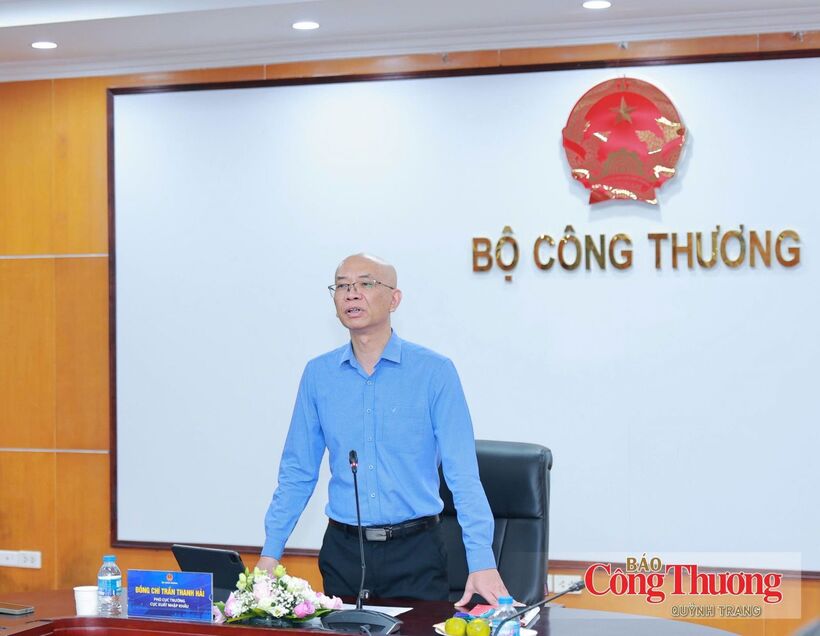
Director Tran Thanh Hai emphasizes the need for inter-ministerial coordination
Another important group of solutions is to promote trade facilitation and risk-based specialized inspections. Ministries responsible for specialized management need to identify duplicate documents, apply the principle of providing data only once, process information before goods arrive, strengthen risk management, and conduct post-clearance inspection where appropriate.
The Agency of Foreign Trade also proposed developing a shared logistics database and coordination platform connecting existing systems to monitor cargo flows, port and warehouse capacity, scheduling, congestion alerts, traceability, and the handling of inter-sectoral problems.
For enterprises, the requirement is to manage logistics based on total landed costs; standardize order data and output forecasts; optimize packaging and loading ratios; control inventories; select delivery terms and alternative routes. Logistics enterprises need to strengthen linkages, develop integrated services, improve multimodal capabilities, and expand cold-chain logistics.
Cost reduction should also be linked to green transition and supply chain resilience. Saving fuel, reducing empty running, improving vehicle utilization, and shifting suitable cargo to inland waterways and railways can both help reduce costs and cut emissions.
From the perspective of the Ministry of Industry and Trade, Tran Thanh Hai said that there were still different approaches to determining and comparing logistics costs. For example, in the textile and apparel industry, logistics costs may account for around 10% of the value of exported goods, while some studies put the figure at around 16-18%. Therefore, through direct dialogue with associations and enterprises, management agencies can obtain more practical information to continue improving policies. Alongside reducing domestic costs, the Ministry of Industry and Trade is leading a program to support Vietnamese enterprises in expanding into global markets.
| According to Tran Thanh Hai, the role of the State is not necessarily to directly undertake work on behalf of enterprises. More importantly, it is to develop policies, mechanisms, provide credit support, and offer appropriate incentives to mobilize social resources. Given limited budgetary resources, support policies need to take into account efficiency and their ability to create incentives for enterprises to invest. |

