


Prime Minister assigns major tasks to Ministry of Industry and Trade in 2026
Prime Minister Le Minh Hung has assigned a series of key tasks to the Ministry of Industry and Trade, emphasizing electricity, petroleum, industry and market development.
The Government Office has issued Notice No. 211/TB-VPCP dated April 24, 2026, announcing the conclusion of Prime Minister Le Minh Hung at a meeting reviewing the implementation of tasks since the beginning of 2026 and outlining key directions for the time ahead of the Ministry of Industry and Trade.
Focus on building and refining draft laws
The Prime Minister acknowledged and highly appreciated the ministry’s proactive and determined efforts in implementing assigned tasks. Despite numerous difficulties and significant challenges, the ministry has strived to overcome obstacles, maintaining growth momentum in industry, import-export activities, and domestic market development, particularly in ensuring stable supplies of petroleum and electricity for economic development and people’s daily life amid complex global developments. These results have contributed positively to the country’s overall achievements in maintaining stability and economic growth.
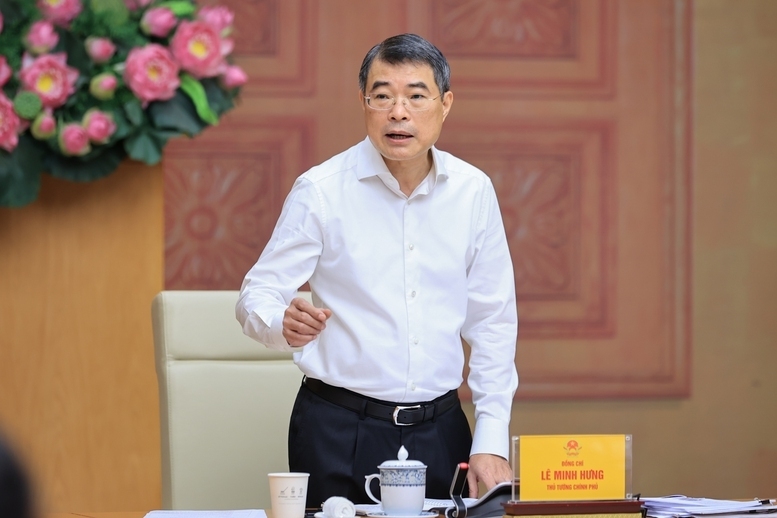
Prime Minister Le Minh Hung chairs a working session with the Ministry of Industry and Trade on the implementation of assigned tasks in 2026. Photo: VGP
In the coming period, the requirement to achieve double-digit growth presents a major challenge, requiring the ministry to clearly identify difficulties arising from global economic instability, prolonged and escalating conflicts, increasing protectionism, and the still-limited internal capacity of domestic enterprises. In addition, the domestic legal system remains overlapping and inconsistent, creating administrative barriers, while ensuring energy security for science, technology and digital transformation development poses significant pressure, especially the risk of electricity shortages during 2027–2030 due to delays in power projects as reported by the ministry and the Government Office. Appropriate solutions are therefore needed to ensure sustainable double-digit growth.
The Prime Minister directed the ministry to urgently review and finalize programs and plans to implement the Resolution of the 14th National Party Congress and Conclusion No. 18-KL/TW, specifying task groups across sectors under the ministry’s management, assigning responsibilities to subordinate units with clear targets and timelines. Leaders of the ministry are required to directly oversee and continuously monitor implementation to ensure progress, quality and efficiency.
The ministry was also asked to continue reviewing and streamlining its organizational structure, building a clean, strong and united Party organization, and developing a lean, disciplined, capable and professional civil service workforce.
At the same time, the ministry must focus on building and refining draft laws included in the legislative program to be submitted to the 16th National Assembly at its second session, including the revised Petroleum Law; amendments and supplements to several laws related to commerce; amendments to the Electricity Law; and the Law on Commodity Derivatives Trading. It is also required to accelerate the development of detailed regulations and implementation guidelines to ensure synchronization upon submission, while coordinating with the Ministry of Justice to propose adding the Law on Key Industries to the 2026 legislative program.
Efforts must be intensified to substantially cut administrative procedures, business conditions, compliance costs and processing time, while strengthening decentralization to localities in line with Conclusion No. 30-KL/TW, ensuring practical effectiveness and completion within April 2026.
No electricity or fuel shortages allowed
Regarding the energy sector, the Prime Minister stressed that this is a critical issue and a prerequisite for economic development, serving digital transformation, big data infrastructure, artificial intelligence development and semiconductor production. Therefore, under no circumstances should electricity or petroleum shortages occur for production and consumption.
To ensure electricity supply, the ministry is tasked with guiding and urging ministries, sectors and localities to implement energy-saving solutions, aiming to reduce at least 3.0% of total national electricity consumption in 2026. During peak summer months (April to July), electricity savings must reach at least 10%, while at least 3,000 MW of peak load capacity should be reduced during high-demand periods when supply-demand imbalance risks arise.
The ministry is also required to promote rooftop solar power for self-production and self-consumption, striving for 10% of public offices and households to install such systems annually, combined with battery energy storage systems (BESS) to reduce peak load pressure and enhance on-site energy autonomy. Mechanisms and policies to accelerate BESS development must be studied and proposed.
It must also study and implement transmission line projects to increase electricity imports from Laos and China to northern Vietnam by 2027, and, if necessary, propose adjustments to intergovernmental agreements and the Power Development Plan VIII to boost electricity imports from Laos.
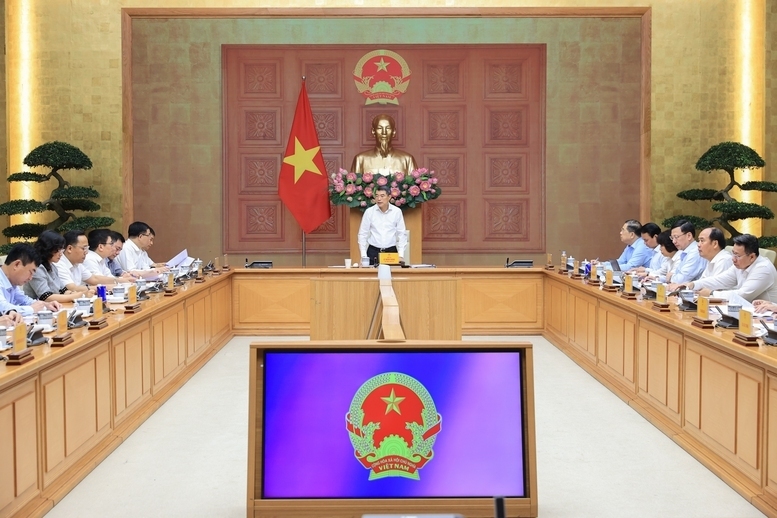
Prime Minister Le Minh Hung stresses that the industry and trade sector must take the lead in shouldering key responsibilities, proactively addressing bottlenecks and driving production and business activities to achieve the set targets. Photo: VGP
Solutions for deploying floating power plants in urgent situations should be considered to ensure sufficient electricity supply, particularly in northern regions.
The ministry is required to urgently review and update the adjusted Power Development Plan VIII, study the development of coal-fired power plants at a reasonable scale with emission treatment roadmaps in line with Conclusion No. 18-KL/TW, and, if necessary, apply emergency mechanisms under the 2024 Electricity Law.
It must accelerate implementation of projects under the plan, directing relevant entities to expedite key thermal power projects such as Na Duong II (110 MW) and An Khanh - Bac Giang (650 MW). At the same time, it must promptly report solutions to address obstacles facing wind and solar projects under the FIT pricing mechanism before April 30, 2026.
A comprehensive review of power projects is required, replacing those unable to meet the 2026–2030 timeline with feasible alternatives, particularly base-load sources, while strictly handling investors failing to meet commitments and clearly defining responsibilities of relevant ministries, agencies and localities. The ministry bears ultimate responsibility for ensuring the implementation of the national power development plan on schedule and promoting efficient energy use.
Local authorities must also be urged to take decisive measures against investors failing to meet project timelines to avoid affecting national power supply.
Regarding petroleum supply, the Prime Minister instructed the ministry to closely monitor market developments, proactively forecast supply-demand balance and ensure stable supply under all circumstances. The petroleum distribution system must be reviewed and streamlined to minimize intermediaries, with a report submitted in the second quarter of 2026. Measures to increase the supply of E10 biofuel should also be studied to reduce dependence on fossil fuels.
In addition, efforts should be strengthened to promote green transport and public transportation systems to reduce fuel consumption. Plans must be developed to invest in strategic petroleum reserves, aiming to reach reserves equivalent to 90 days of net imports.
Boosting industry, expanding markets and addressing recommendations
In industrial production, the ministry is required to urgently finalize the draft Law on Key Industries, incorporating strong and specific mechanisms and policies to accelerate large-scale industrial projects, enhance investment attraction, and promote the development of processing, manufacturing and supporting industries. At the same time, it must restructure industrial production chains, strengthen domestic production autonomy, reduce dependence on imported raw materials, and increase localization rates, moving toward deeper integration into global supply chains.
The ministry is also tasked with expeditiously completing the national strategy on rare earths in line with guidance from competent authorities under Document No. 32-TB/VPTW dated April 2, 2026, and submitting it to the Prime Minister in May 2026.

