


Acting Minister Le Manh Hung calls for greater EAEU market access for Vietnamese seafood
According to Acting Minister of Industry and Trade Le Manh Hung, the Vietnam - EAEU Free Trade Agreement (VN-EAEU FTA) has contributed significantly to promoting bilateral trade. In the coming period, he urged the Eurasian Economic Union (EAEU) to further open its market to Vietnamese seafood products.
On March 2, 2026, at the headquarters of the Ministry of Industry and Trade, Acting Minister Le Manh Hung held talks with Bakytzhan Sagintayev, Chairman of the Board of the Eurasian Economic Commission (EEC), on the occasion of the Chairman’s visit to Vietnam.
At the meeting, Acting Minister Le Manh Hung affirmed that the Eurasian Economic Union remains a traditional, reliable and important trading partner of Vietnam. The EAEU was the first economic bloc in Europe to sign a free trade agreement with Vietnam. Over the past decade, the VN-EAEU FTA has delivered noteworthy results for all participating countries.
After 10 years of implementation, the agreement has achieved highly positive outcomes. Approximately 60% of tariff lines were reduced to zero immediately upon the agreement’s entry into force in 2016. The remaining tariffs have been eliminated according to a 10-year roadmap, which was largely completed in 2025.
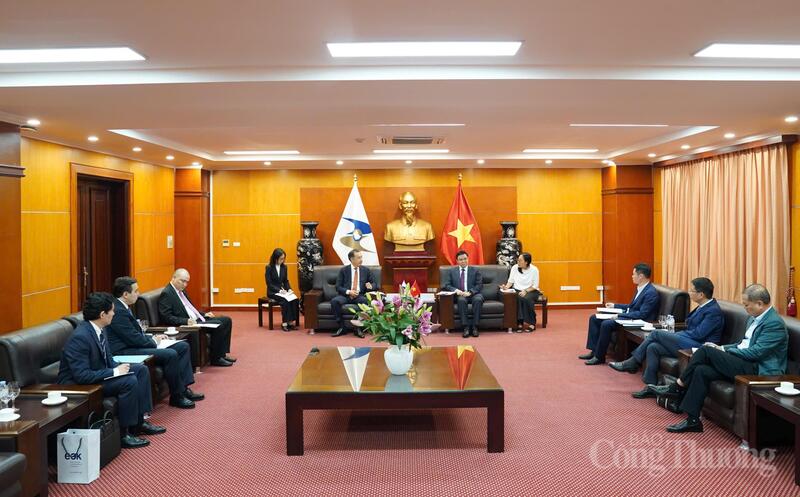
Overview of the meeting between Acting Minister Le Manh Hung and Bakytzhan Sagintayev, Chairman of the Board of the Eurasian Economic Commission (EEC).
The agreement has played a vital role in boosting bilateral trade. Total import-export turnover increased from 3.04 billion USD in 2016 to 5.94 billion USD in 2025, nearly doubling over the decade. During the 2017 - 2018 period, trade grew at an average annual rate of nearly 30%. Although trade was adversely affected by the COVID-19 pandemic and the Russia - Ukraine conflict between 2019 and 2022, it rebounded from 2023 and continued to expand in 2024 and 2025.
The trade structure between the two sides is complementary, enabling businesses to make effective use of tariff preferences and enhance competitiveness. Many of Vietnam’s key export products have recorded strong growth thanks to preferential treatment under the VN-EAEU FTA, including seafood, coffee, pepper, cashew nuts and textiles exported to the EAEU market.
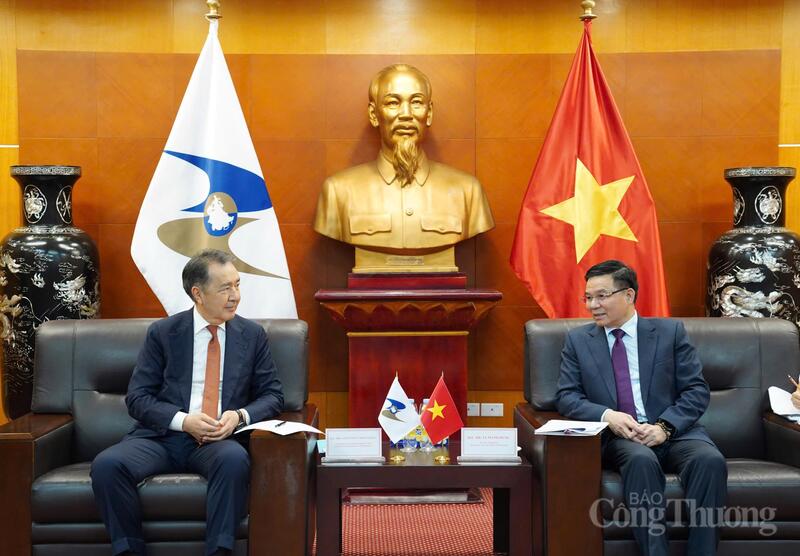
At the meeting, Acting Minister Le Manh Hung called on the Russian Federation and the EAEU to further open their markets to Vietnamese seafood.
However, the Acting Minister also noted that several issues remain to be addressed. Vietnam has proposed that the EAEU refrain from continuing the application of the trigger safeguard mechanism on Vietnamese textile products, arguing that the measure is no longer consistent with market realities or international practice. At the same time, Vietnam has called on the Russian Federation and the EAEU to further open their markets to Vietnamese seafood, consider lifting suspensions, and approve additional enterprises eligible to export. Vietnam also requested that the EAEU share data on preferential imports to facilitate assessments of the agreement’s implementation.
For his part, EEC Chairman Bakytzhan Sagintayev congratulated Acting Minister Le Manh Hung on his new role and commended the coordinating function of the Joint Committee overseeing the agreement’s implementation. He expressed confidence that, in his capacity as co-chair of the Joint Committee, the Acting Minister would actively work to resolve outstanding issues and help build a solid cooperation framework to deepen relations between Vietnam and EAEU member states, delivering tangible benefits for both sides.
Sagintayev reaffirmed that the VN-EAEU FTA has contributed positively to trade growth between the parties. He welcomed the steady expansion of bilateral trade turnover and expressed confidence that, building on the positive results achieved, cooperation would continue to develop robustly in the coming years.
Both sides agreed to facilitate market access, promptly remove trade barriers, and address obstacles in order to meet cooperation demands and fully tap into the economic potential of Vietnam and the EAEU. They also reaffirmed their commitment to promoting supply diversification and expanding market access for each other, thereby enhancing competitiveness and mitigating geopolitical risks that could disrupt supply chains.

