


Minister Le Manh Hung explains, incorporates feedback into draft revised Petroleum Law
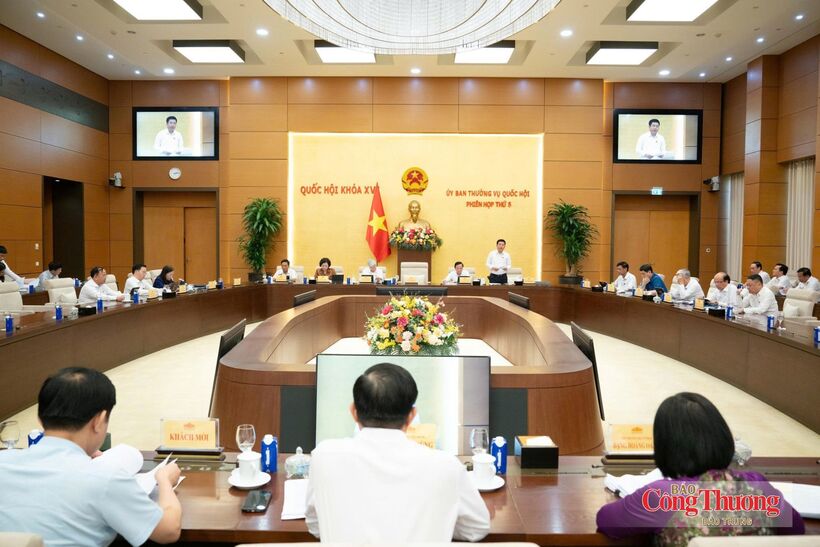
On the afternoon of August 17, chaired by Vice Chairman of the National Assembly Nguyen Hong Dien, the National Assembly Standing Committee gave its opinions on the explanation, incorporation and revision of the draft revised Petroleum Law.
Ensuring constitutionality and legality
Authorized by the Prime Minister, Minister of Industry and Trade Le Manh Hung presented a summary report on the incorporation and explanation of opinions raised by National Assembly (NA) deputies in panel discussions and at the plenary session, as well as the review opinions of the NA's Economic and Financial Committee on the draft law.
Minister Le Manh Hung said most NA deputies agreed on the need to enact the law to further institutionalize the Party's guidelines and policies to ensure national energy security, develop the petroleum industry, science and technology, innovation, and the marine economy. In addition, the draft revised Petroleum Law ensures constitutionality and legality, consistency with the legal system and relevant international treaties, and compliance with national defense and security requirements, while cutting administrative procedures and stepping up decentralization and delegation of authority linked to inspection, oversight and accountability.
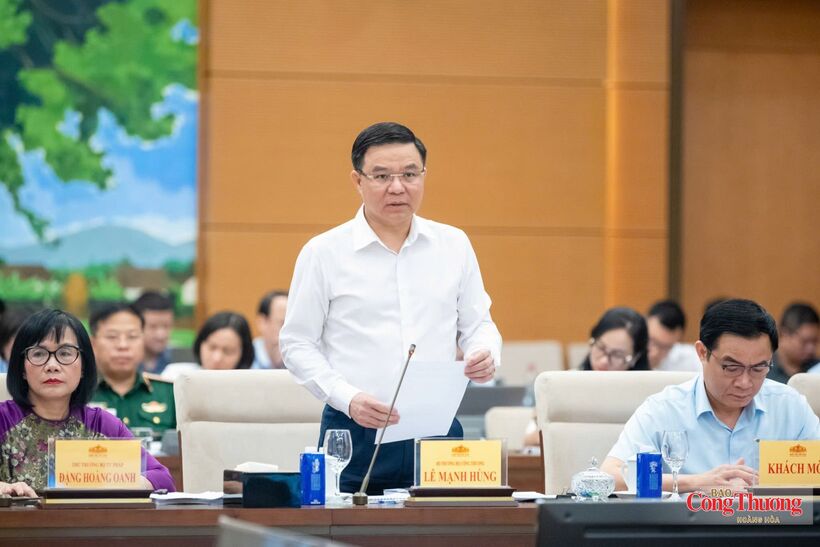
Minister of Industry and Trade Le Manh Hung presents a summary report on the incorporation and explanation of opinions from NA deputies and the review opinions of the NA's Economic and Financial Committee on the draft law.
Briefing on a number of issues that NA deputies have raised concerns about and commented on recently, Minister Le Manh Hung said the drafting agency has incorporated and revised the following contents:
First, on carbon capture and storage (CCS) and offshore energy facilities linked to petroleum operations. The Government has revised the draft to regulate CCS activities directly linked to petroleum operations. It has also clarified contractors' rights to carbon credits, and their responsibility for monitoring, surveillance and remediation after field closure. For offshore energy facilities, shared use of existing infrastructure is encouraged, provided safety is ensured and petroleum operations are not affected.
Second, on high-tech petroleum technical services, the Government has narrowed the scope of application to high-tech services that directly serve basic surveys and upstream petroleum operations. Specific identification criteria have been added, while investment, tax and land incentives will follow specialized laws, with a focus on encouraging research, application, mastery and transfer of technology.
Third, on decentralization, delegation of authority and the role of Petrovietnam, the Government has revised the draft to clearly define Petrovietnam's functions, separating basic survey activities, its role as an investor, and specific functions assigned by the State. It has also added a post-review mechanism requiring Petrovietnam to periodically report to the state management agency for petroleum activities, the Ministry of Industry and Trade. In addition, matters related to national defense, security and force majeure will still be approved by the state petroleum management agency to ensure direct control.
Fourth, on incentive policies and marginal-field production, the Government will maintain existing special incentive levels to ensure stability and predictability in the investment environment. It has also clarified the Prime Minister's authority over especially important projects, and set an enhanced oil recovery (EOR) incentive of no more than 10% of additional recoverable costs. A mechanism for handling funds related to marginal-field production has also been added, to ensure decommissioning obligations and environmental responsibilities are met.
Fifth, on petroleum contracts, the Government has clarified the principles for determining cases of contract adjustment and extension periods (not exceeding 15 years for enhanced oil recovery). Provisions on cost recovery, contract termination and dispute resolution are inherited from current law to protect contractors' legitimate rights and interests.
Sixth, on field development plans (ODP, EDP, FDP), these are specialized dossiers unique to the petroleum industry that may replace pre-feasibility/feasibility study reports to avoid duplication, but must still comply with land, environmental, national defense-security and other specialized laws.
Seventh, on handling Petrovietnam's costs. The Government has clarified the funding sources for basic surveys, separated corporate finances, and added a transitional mechanism for handling costs incurred before the 2022 Petroleum Law took effect.
Discussing and giving opinions on the draft law, delegates highly appreciated the receptive spirit of the drafting agency and the Standing Body of the Economic and Financial Committee in seriously studying and incorporating NA deputies' opinions to finalize the draft law for the National Assembly's consideration and passage.
Swiftly developing detailed guiding documents
Addressing the feedback raised at the session, Minister Le Manh Hung, on behalf of the drafting agency, extended his sincere thanks for the in-depth, responsible contributions from the Standing Body of the Economic and Financial Committee, the NA's committees and the deputies.
The minister highlighted a number of key tasks the Government will focus on in the coming days:
First, developing detailed guiding documents. The Government and the drafting agency will direct the development of a decree detailing the law's implementation, specifying the decentralized and delegated authority assigned to the Ministry of Industry and Trade and Petrovietnam, along with strict oversight and power-control mechanisms.
Second, the Government will pay attention to establishing principles for transparently handling Petrovietnam's costs. It will also review issues that arose before 2022 and thoroughly resolve them.
Third, continuing to build a comprehensive legal framework for CCS activities and independent offshore energy projects, ensuring an overall, long-term and legally sound, feasible basis for the effective rollout of this new area of investment.
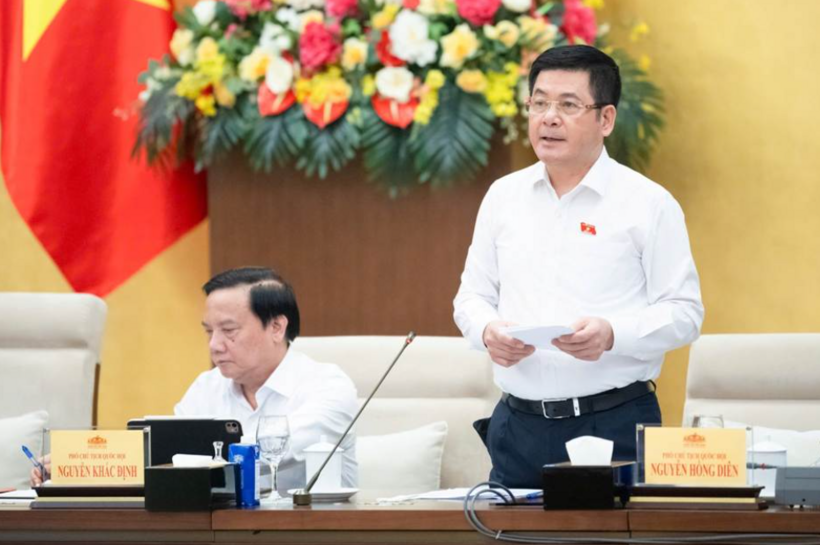
Vice Chairman of the National Assembly Nguyen Hong Dien delivers closing remarks at the session.
Delivering closing remarks at the discussion session, Vice Chairman of the National Assembly Nguyen Hong Dien praised the close, responsible coordination between the drafting agency (the Ministry of Industry and Trade) and the reviewing agency (the Economic and Financial Committee) in incorporating NA deputies' opinions to the fullest extent. The Vice Chairman requested that the Government continue directing ministries and sectors to coordinate with the Ministry of Justice to review and finalize the draft law and urgently draft implementation guiding documents.
| Based on the outcome of the session, the National Assembly Standing Committee agreed to submit the draft revised Petroleum Law to the National Assembly for consideration and approval after it is incorporated and revised in line with the conclusions of this session. The Government is fully responsible for incorporating, revising and finalizing the draft law, ensuring progress on both content and legislative technique, for submission to the National Assembly at its first extraordinary session of the 16th tenure. |

