


Vietnam - EFTA economic cooperation enters a new stage of development
In an interview with the press regarding the Free Trade Agreement (FTA) between Vietnam and the European Free Trade Association (EFTA), Deputy Minister of Industry and Trade Nguyen Sinh Nhat Tan emphasized that the agreement will lay the foundation for economic relations between Vietnam and EFTA to enter a new stage of development.
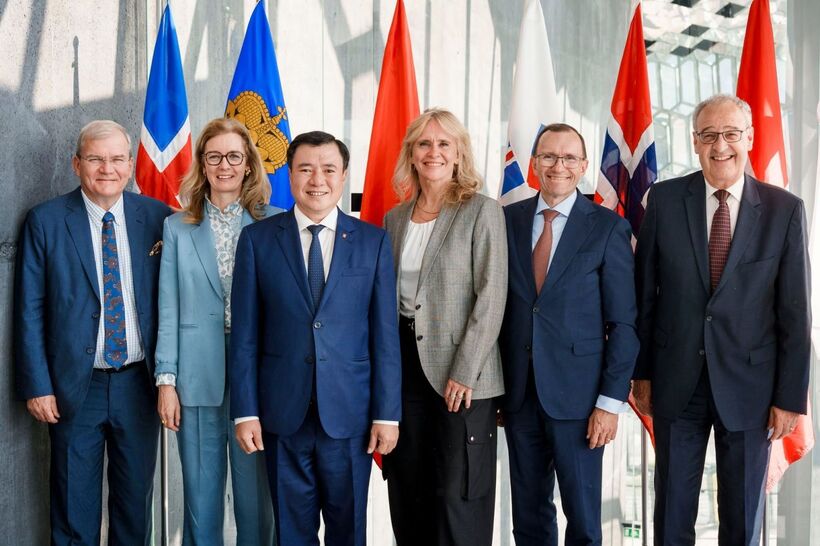
Deputy Minister of Industry and Trade Nguyen Sinh Nhat Tan leads the Vietnamese negotiating delegation to the EFTA Ministerial Meeting in Iceland. Photo: Multilateral Trade Policy Department.
- After more than a decade of negotiations, Vietnam and EFTA have officially concluded negotiations on the FTA. What significance does this agreement hold amid growing volatility in global trade and increasing protectionism, Deputy Minister?
Deputy Minister Nguyen Sinh Nhat Tan: The Vietnam - EFTA Free Trade Agreement was concluded at a particularly significant time, when the global economy is facing numerous challenges arising from geopolitical tensions, climate change, supply chain disruptions, and the increasing trend of trade barriers.
In this context, the conclusion of negotiations is not merely the end of a process that lasted more than a decade. It also demonstrates the strong commitment of Vietnam and the EFTA countries to an open, free, transparent and rules-based international trading system. This sends a message that dialogue, cooperation and economic integration remain the most effective path to promoting growth, creating jobs and bringing prosperity to people.
The agreement also connects two groups of economies with highly complementary characteristics. EFTA countries possess leading strengths in technology, innovation, finance, clean energy and sustainable development, while Vietnam is one of Asia's most dynamic economies and is increasingly affirming its role as a regional center for manufacturing, trade and investment.
More importantly, the agreement will lay the foundation for economic relations between Vietnam and EFTA to enter a new stage of development, with a stable, transparent and predictable business environment, thereby further promoting flows of trade, investment, technology and knowledge between the two sides.
- EFTA comprises economies with very high standards in quality, environmental protection, sustainable development and innovation. Could you tell us what specific opportunities this agreement will create for Vietnamese businesses, particularly in exports, investment attraction and deeper participation in global value chains?
Deputy Minister Nguyen Sinh Nhat Tan: The agreement will create many practical opportunities for Vietnam's business community.
First, it will contribute to the diversification of export markets, creating favorable conditions for Vietnamese goods to gain better access to markets with strong purchasing power and some of the world's highest quality requirements, including Iceland, Liechtenstein, Norway and Switzerland.
In addition, the agreement is expected to attract high-quality investment flows from EFTA countries into sectors prioritized by Vietnam, such as high technology, processing industries, clean energy, green transition, innovation and human resource development. This is not only a source of capital but also an opportunity to acquire advanced technologies, management experience and sustainable development models.
For Vietnamese enterprises, cooperation with EFTA partners will help improve competitiveness and gradually enable them to meet higher international standards, thereby participating more deeply in global value chains.
Conversely, with a market of more than 100 million people, a strategic location in the Asia-Pacific region and a network of 17 free trade agreements already established, Vietnam also wishes to become a reliable partner and a bridge for EFTA enterprises to expand their presence in ASEAN and regional markets. This will create long-term opportunities for investment, production and business cooperation, bringing benefits to enterprises on both sides.
- Following the conclusion of negotiations, what measures will the Ministry of Industry and Trade take to help businesses make effective use of this FTA at an early stage, from disseminating commitments and rules of origin to enhancing their capacity to meet the stringent standards of EFTA markets?
Deputy Minister Nguyen Sinh Nhat Tan: The conclusion of negotiations is a very important milestone, but it is only the beginning. The success of the agreement will be measured by the extent to which the business community utilizes it and by the tangible benefits it brings to the economy and the people.
In the coming period, the Ministry of Industry and Trade will continue to coordinate closely with ministries, sectors, localities and EFTA countries to complete the legal review process and prepare for the signing and implementation of the agreement in accordance with the agreed roadmap.
At the same time, the ministry will step up efforts to disseminate and comprehensively communicate the commitments of the agreement to the business community; organize training programs on rules of origin, technical regulations, quality standards, environmental requirements and sustainable development; and develop accessible guidance materials so that businesses can quickly understand and make use of the agreement's preferences.
In addition, the ministry will strengthen trade promotion activities, facilitate business connections and support enterprises in participating more deeply in the supply chains and value chains of EFTA partners. It will also coordinate with relevant ministries and sectors to improve the investment and business environment and enhance the competitiveness of enterprises and the economy.
For its part, the Vietnamese Government remains committed to accelerating institutional reforms, improving the investment and business environment, and fully and seriously implementing the international commitments that have been agreed upon, thereby creating the most favorable conditions for the business communities of both Vietnam and EFTA to effectively seize the opportunities generated by the agreement.
Notably, the Government recently issued Decree No. 240/ND-CP dated June 26, 2026, detailing and providing measures for the implementation of a number of provisions on mechanisms and policies for mobilizing resources to develop and operate the ecosystem for utilizing free trade agreements and the Export Promotion Fund for industry sectors. The decree is expected to help businesses maximize the benefits arising from the Vietnam - EFTA FTA.
- Thank you very much, Deputy Minister.
The European Free Trade Association (EFTA) comprises four member states: Switzerland, Norway, Iceland and Liechtenstein. Vietnam and EFTA have held 21 rounds of official negotiations, with the latest round taking place in Iceland from June 17 to 22. According to the Multilateral Trade Policy Department under the Ministry of Industry and Trade, the two sides issued a Joint Declaration on July 2 announcing the conclusion of negotiations on the Vietnam -EFTA Free Trade Agreement. The agreement is expected to usher in a new phase of cooperation, laying a solid foundation for promoting trade and investment and expanding cooperation across various fields between Vietnam and the EFTA states. On June 22, Deputy Minister of Industry and Trade Nguyen Sinh Nhat Tan led the Vietnamese negotiating delegation to attend the EFTA Ministerial Conference in Liechtenstein to discuss the issues before concluding the negotiations. According to data from the Multilateral Trade Policy Department, trade turnover between EFTA and Vietnam reached EUR 4.8 billion in 2025, with Vietnam recording a trade surplus of EUR 2.5 billion, a sharp increase from EUR 0.5 billion a decade earlier, excluding Switzerland's gold trade data. EFTA's main exports to Vietnam include electrical machinery, seafood, pharmaceuticals and mechanical machinery, while Vietnam's principal exports to EFTA markets are electrical machinery, footwear, garments and textiles, and mechanical machinery. |

