


The National Assembly officially passes the E-Commerce law
On the morning of December 10, the National Assembly adopted the law on E-commerce with 444 out of 446 deputies present voting in favour.
According to the Law on Promulgation of Legal Normative Documents, the Government instructed the drafting agency to thoroughly review and incorporate legitimate recommendations from National Assembly deputies, the appraisal agency and conclusions of the National Assembly Standing Committee. These inputs were fully reflected in the revised draft of the Law on E-commerce submitted for approval.
On behalf of the Government, Minister of Industry and Trade Nguyen Hong Dien delivered the report on revisions and explanations before the National Assembly.

Minister of Industry and Trade Nguyen Hong Dien deliveres the report on revisions and explanations before the National Assembly.
Clarifying obligations for social media e-commerce and livestreamed sales
Responding to comments from deputies, the drafting agency defined clear responsibilities for all actors involved in livestreamed sales, including sellers, hosts and platform operators, to enhance transparency, strengthen legal accountability and support inspections, supervision and enforcement.
For social media platforms engaging in e-commerce activities, the law establishes them as a distinct category with obligations tailored to their operational nature. While not applying intermediary platform regulations mechanically, the law ensures no regulatory gaps exist, especially regarding content management, coordination in handling violations and consumer protection.
Strengthening seller identification and market transparency
Provisions on seller identification draw on the national electronic identification and authentication system (VNeID). This aims to improve market transparency, curb counterfeit and IP-infringing goods through better traceability, and assist tax authorities in preventing revenue losses.
The Government reaffirmed the principle of maximising the use of existing digital infrastructure and state data to avoid unnecessary administrative procedures for citizens and enterprises while ensuring that authorities retain effective enforcement tools.

The National Assembly convenes a plenary session on December 10.
Responsibilities of foreign platforms operating in Vietnam
In line with deputies' feedback, revisions were made based on the operational model and functions of e-commerce platforms. Requirements on appointing authorised representatives or establishing legal entities in Vietnam will be determined according to each platform’s structure and activities, ensuring consistency with international commitments while enhancing state management and safeguarding lawful consumer interests.
Ensuring timely issuance of implementing regulations
Immediately after the law’s adoption, the Government will issue an implementation roadmap, ensuring that all guiding documents are clear, feasible and consistent with related legislation, without creating new administrative burdens. The plan will also emphasise risk-based supervision, data-driven post-inspection, and clearly defined responsibilities for all actors in e-commerce. Importantly, these guiding documents will take effect concurrently with the law.
Addressing detailed recommendations from deputies
Deputies also commented on specific aspects of the draft, including: (1) transaction thresholds for foreign platforms; (2) deposit requirements for certain foreign platforms to guarantee compensation for consumers and fulfil financial obligations to the State; (3) reporting mechanisms; (4) administrative procedures and (5) violation handling and policies promoting e-commerce development.
Minister Dien affirmed that these suggestions had been fully absorbed and will be further detailed in the implementing decrees, in line with Resolution 66, Resolution 68 of the Party Central Committee and Resolution 198/2025 of the National Assembly. The guiding documents will continue to streamline administrative procedures, simplify regulations, reduce compliance costs and avoid new bottlenecks for production and business activities.
“With a spirit of responsibility and receptiveness to feedback from National Assembly deputies, the Standing Committee and the appraisal agency, the Government believes that the revised draft Law on E-commerce reflects greater coherence and alignment with Party and State policies. It meets the requirements of state management in the digital economy while protecting the legitimate rights and interests of consumers and ensuring a transparent, fair business environment,” Minister Dien said.
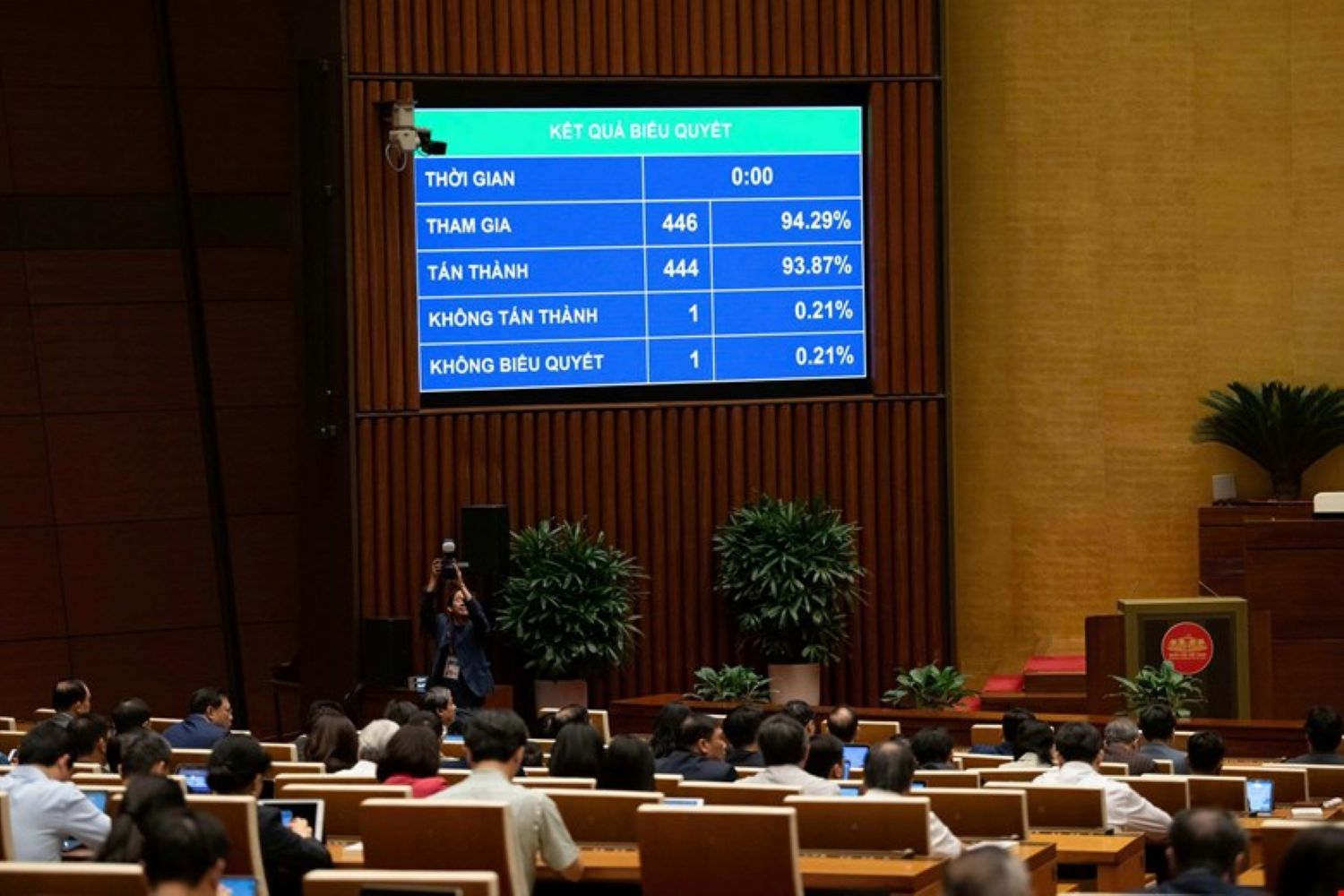
The National Assembly approves the E-Commerce Law, with 444 out of 446 deputies present voting in favor.
Scope and entry into force
The Law on E-commerce comprises 7 chapters and 41 articles. It provides regulations on e-commerce development policies; e-commerce platforms and responsibilities of organisations and individuals participating in e-commerce; cross-border e-commerce; responsibilities of entities providing supporting services; and the application of technology in enforcement and violation handling.
The law applies to both domestic and foreign organisations and individuals engaged in e-commerce activities in Vietnam and will take effect on July 1, 2026.

