


Ministry of Industry and Trade holds regular press conference for the second quarter of 2026
On the afternoon of July 7, at the headquarters of the Ministry of Industry and Trade (MoIT), Deputy Minister Nguyen Sinh Nhat Tan, spokesperson for the ministry, chaired the MoIT's regular press conference for the second quarter of 2026.
The event was attended by representatives of the ministry's functional units and more than 100 journalists and reporters from news agencies and media organizations.

Deputy Minister Nguyen Sinh Nhat Tan, spokesperson for the Ministry of Industry and Trade (MoIT), chairs the press conference.
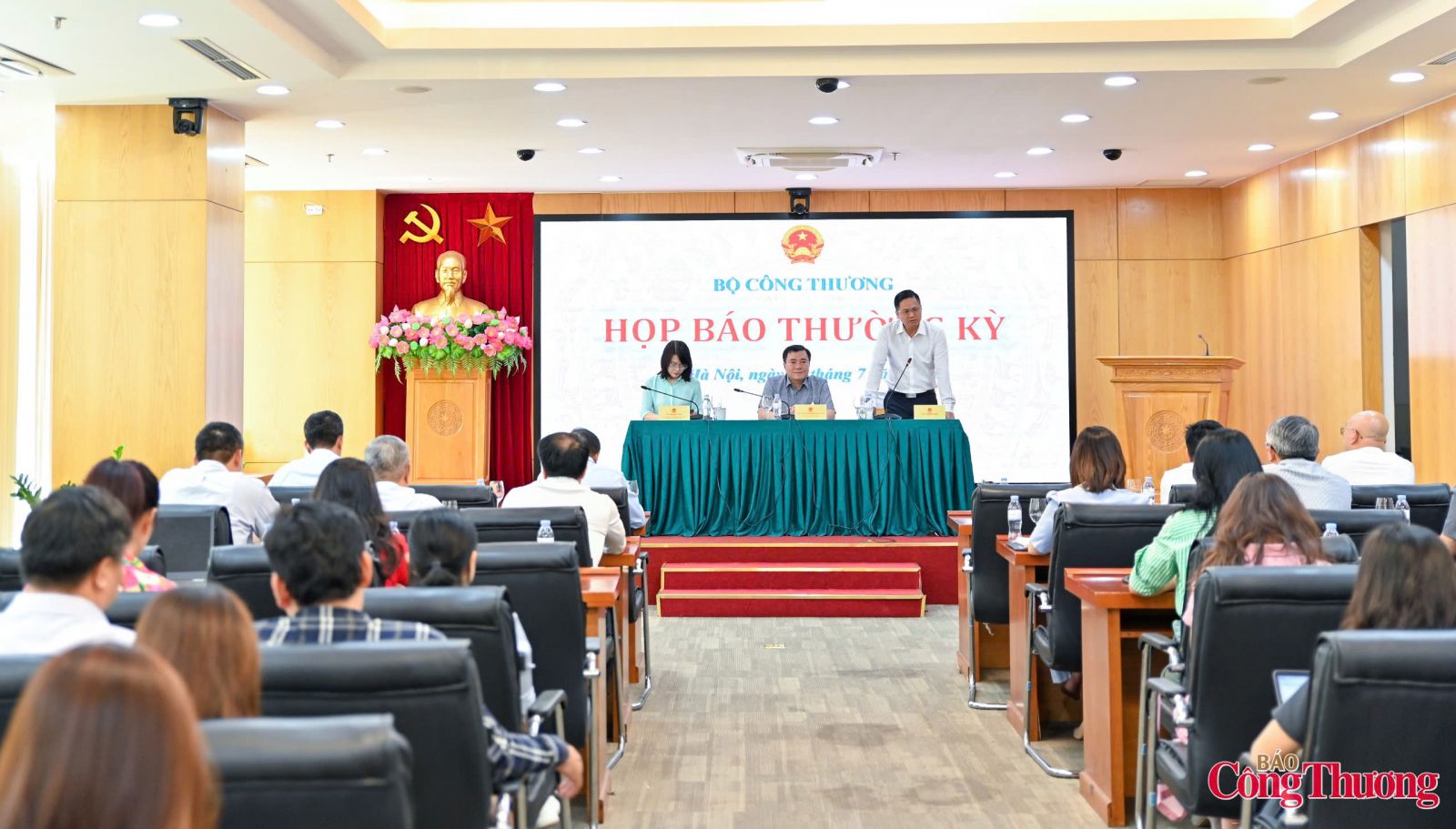
The MoIT's regular press conference for the second quarter of 2026.
Presenting a report at the press conference, Mai Thu Hien, Deputy Director of the Department of Planning, Finance and Enterprise Management under the MoIT, said that during the first six months of 2026, the global landscape continued to evolve rapidly, becoming increasingly complex and unpredictable. Strategic competition among major powers, the growing trend of trade protectionism, geopolitical conflicts, particularly in the Middle East, together with volatility in global energy markets and supply chains, exerted significant pressure on production, trade and investment activities.
Against this backdrop, the MoIT closely followed the directions of the Party Central Committee, the National Assembly, the Government and the Prime Minister, while proactively implementing comprehensive measures to promote industrial development, ensure energy security, develop the domestic market and boost exports. These efforts continued to affirm the ministry's role as one of the key drivers contributing to Vietnam's GDP growth of 8.18% in the first half of the year.
Regarding the firm safeguarding of national energy security, amid surging energy demand and heightened volatility in global energy markets, the MoIT proactively managed operations to ensure the adequate supply of electricity, petroleum products and other essential energy sources for production, business activities and people's daily lives. The national power system operated safely and stably, while electricity production and imports reached approximately 171.07 billion kWh, up 9.57% year on year, meeting the requirements for socio-economic development.
Regarding petroleum products, the ministry closely monitored developments in the international market, promptly advised on appropriate regulatory measures, and coordinated with key petroleum traders to ensure adequate supplies and maintain stability in the domestic market, preventing supply disruptions even as the conflict in the Middle East heightened volatility in global oil prices. At the same time, the ministry advised on the implementation of the roadmap for the use of biofuel starting June 1, 2026, contributing to the promotion of a greener and more sustainable energy transition.
Regarding industrial production, which continued to recover strongly and remained a key driver of economic growth, the Index of Industrial Production (IIP) was estimated to increase by 11.2% year on year in the second quarter of 2026, with the manufacturing and processing sector rising by 11.3% and electricity production and distribution increasing by 12.4%. For the first six months of 2026, the IIP was estimated to grow by 10.8% from a year earlier, compared with an increase of 8.7% in the same period of 2025. Within the overall figure, the manufacturing and processing sector expanded by 11.4%, compared with 10.5% in the corresponding period of 2025, while electricity production and distribution grew by 9.6%, up from 4.1% a year earlier. Several localities recorded exceptionally strong industrial growth, including Ha Tinh, Ninh Binh, Phu Tho, Nghe An, Thai Nguyen and Bac Ninh. By the end of the first half of the year, 13 out of 34 localities had achieved or exceeded their annual industrial growth targets. However, 15 out of 34 localities had yet to meet their targets, requiring stronger acceleration in the second half of the year.
Regarding the domestic market, which continued to serve as a pillar of the economy, total retail sales of goods and consumer service revenue maintained robust growth, with second-quarter 2026 figures estimated to increase by 13.9% year on year. For the first six months of 2026, the figure was estimated to rise by 12.9% from a year earlier, approaching the full-year target. Goods supply remained sufficient, the market stayed generally stable, and no shortages or unusual price fluctuations were recorded for essential commodities. The MoIT effectively implemented programs to stimulate consumer demand, strengthen supply-demand connectivity, develop distribution networks and e-commerce, and promote the "Vietnamese people give priority to using Vietnamese goods" campaign, thereby helping reinforce domestic purchasing power and support businesses in expanding their markets.
Regarding exports and imports, which continued to be a bright spot of the economy, export turnover reached USD 143.6 billion in the second quarter of 2026, up 22.7% year on year, while import turnover totaled USD 156.6 billion, an increase of 39.1% from a year earlier. In the first six months of the year, total import-export turnover was estimated at approximately USD 549.69 billion, up 27.1% year on year. Of the total:
Merchandise exports reached USD 266.52 billion, up 21.0% from a year earlier. The domestic economic sector generated USD 53.51 billion, up 4.6%, accounting for 20.1% of total export turnover, while the foreign-invested sector, including crude oil, recorded USD 213.01 billion, up 26.0%, accounting for 79.9%. A total of 29 export commodities posted export turnover exceeding USD 1 billion, representing 92.1% of total merchandise exports, including five commodities with export turnover of more than USD 10 billion, accounting for 62.6%. Exports of processed and manufactured industrial products reached USD 239.8 billion, making up 90.0% of total export turnover. The US remained Vietnam's largest export market, with export turnover reaching USD 86.5 billion. Vietnam's trade surplus with the US stood at USD 75.3 billion, up 21.3% year on year.
Merchandise imports reached USD 283.17 billion, up 33.4% from a year earlier. The domestic economic sector imported goods worth USD 78.46 billion, an increase of 24.3%, while the foreign-invested sector recorded imports valued at USD 204.71 billion, up 37.3%. A total of 38 imported commodities registered import turnover exceeding USD 1 billion, accounting for 92.1% of total merchandise imports, including two commodities with import turnover of more than USD 10 billion, representing 51.0%. China remained Vietnam's largest import market, with import turnover reaching USD 115.2 billion. Vietnam's trade deficit with China amounted to USD 77.3 billion, up 39.0% year on year. Import growth was driven mainly by machinery, equipment, components and production materials, reflecting the trend of expanding investment and production capacity among enterprises. Imports of means of production reached USD 266.4 billion, accounting for 94.1% of total imports, of which machinery, equipment, tools and spare parts accounted for 56.0%, while raw materials and fuels represented 38.1%.
Vietnam recorded a merchandise trade deficit of USD 2.64 billion in June. For the first six months of 2026, the merchandise trade deficit totaled USD 16.65 billion, compared with a trade surplus of USD 7.95 billion in the same period last year. Of the total, the domestic economic sector posted a trade deficit of USD 24.95 billion, while the foreign-invested sector, including crude oil, recorded a trade surplus of USD 8.3 billion.
The MoIT also proactively leveraged free trade agreements (FTAs) to diversify export markets while strengthening its early warning system and supporting businesses in responding to trade remedy measures and emerging requirements related to green development, product traceability and carbon emissions.
To implement its key tasks for the second half of 2026, the MoIT will continue to closely follow the directions of the Party Central Committee, the National Assembly and the Government, while proactively monitoring developments to promptly advise on appropriate regulatory measures and focus on carrying out several key priorities.
First, the ministry will continue to firmly safeguard national energy security by ensuring adequate supplies of electricity, petroleum products and other essential energy sources. It will also accelerate the implementation of key power generation and transmission projects and effectively carry out the revised National Power Development Plan VIII.
Second, the ministry will promote industrial production by addressing difficulties faced by businesses, advancing the development of the processing and manufacturing industries, supporting industries and high-tech sectors, while coordinating with localities to expedite industrial and energy projects that are capable of being commissioned within 2026.
Third, the ministry will further develop the domestic market by effectively implementing consumer demand stimulus programs, expanding modern distribution networks, e-commerce and logistics, while strengthening market surveillance and intensifying efforts to combat smuggling, trade fraud and counterfeit goods.
Fourth, the ministry will further promote exports and improve the quality of trade growth by continuing to diversify export markets, making more effective use of FTAs, supporting businesses in meeting new standards imposed by importing markets, and enhancing their capacity to respond to trade remedy measures.
At the same time, the ministry will continue improving the institutional framework, reforming administrative procedures, accelerating digital transformation, and working closely with the business community to promptly address difficulties, enhance competitiveness and strengthen enterprises' integration into global value chains.
At the press conference, Deputy Minister Nguyen Sinh Nhat Tan and representatives of the ministry's functional units answered a wide range of questions from reporters regarding issues under the MoIT's management that have attracted public attention.
Ngoc An, reporter from Tuoi Tre News (Ho Chi Minh City):
Question 1: Previously, the Electricity Authority of Vietnam drew up a policy to support the development of rooftop solar power, including a proposal to use state and local budgets to help households install rooftop solar systems. Amid rising demand for electricity, especially household electricity consumption, could the Ministry of Industry and Trade update us on the progress of this policy: has it been submitted to the Government, and when is it expected to be issued?

Bui Quoc Hung, Deputy Director of the Electricity Authority of Vietnam
Bui Quoc Hung, Deputy Director of the Electricity Authority of Vietnam, replied:
Regarding the policy to support households installing self-generated, self-consumed power systems and electricity storage systems, the Ministry of Industry and Trade (MoIT) has drafted a Decision of the Prime Minister as required by regulations. This Decision has not yet been issued, as it is necessary to identify a feasible budget source and reach agreement on the credit institution responsible for implementing the policy.
However, the Electricity Law has also assigned provincial People's Councils the task of issuing appropriate local support policies based on the socio-economic conditions of each period.
In addition, on June 26, 2026, the Government issued Decree No. 243/2026/ND-CP, amending a number of regulations on the development of rooftop solar power. This Decree has created very favorable conditions for people to develop self-generated, self-consumed rooftop solar power.
Question 2: Regarding EVN's proposal to invest in an additional roughly 1,700 MW of battery energy storage systems (BESS), what is MoIT's view and approach to handling this proposal?
Bui Quoc Hung, Deputy Director of the Electricity Authority of Vietnam, replied:
Under the national power development plan, the development of battery energy storage systems (BESS) has been oriented to serve system needs and to be combined with renewable energy, arranged in a distributed manner near wind and solar power centers or on the power grid at load centers. By 2030, capacity is expected to reach around 10,000-16,300 MW. Of this, the development of centralized solar power must be combined with the installation of battery storage at a minimum ratio of 10% of capacity, storing electricity for 2 hours.
MoIT has also allocated BESS capacity to localities as well as to EVN as a basis for investment and construction under regulations. EVN has, in turn, assigned installation targets by phase to the Northern, Central and Southern Power Corporations, as well as to the Hanoi and Ho Chi Minh City Power Corporations. At present, the Northern Power Corporation and the Hanoi Power Corporation – areas with rapidly rising load and continuing difficulties in ensuring electricity supply, are building and installing this storage system on the distribution grid at 110 kV substations. In addition, investors in centralized solar power projects are also strictly complying with the principle of installing BESS as required during project implementation, while localities are actively proposing the installation of standalone BESS capacity in their areas to serve system needs.
Question 3: At present, smuggled sugar, particularly from Thailand, is creating major difficulties for sugarcane farmers and the domestic sugar industry. Meanwhile, the Dak Lak Provincial National Assembly Delegation has proposed continuing to apply trade remedy measures on sugar, while also stepping up controls on smuggled sugar. Could MoIT tell us what solutions will be taken to protect the domestic sugarcane and sugar industry?

Chu Thang Trung, Deputy Director of the Trade Remedies Authority of Vietnam
Chu Thang Trung, Deputy Director of the Trade Remedies Authority of Vietnam, replied:
Regarding the continued application of anti-dumping and anti-subsidy measures on sugarcane imported from Thailand, I would like to share the following.
The anti-dumping and anti-subsidy measures on imported sugarcane products from Thailand have been applied by MoIT since June 15, 2021. Under the law, after 5 years of application, the investigating authority must conduct a review to assess the effectiveness of the measures and consider whether to extend them.
Through the review, assessment and data collection process from the domestic sugar and sugarcane industries, the Trade Remedies Authority (TRAV) has recorded a number of notable results.
First, the trade remedy measures have helped maintain a fair competitive environment between domestic sugar production and sugar imported from Thailand.
The volume of sugar imported from Thailand has fallen sharply, from around 924,000 tonnes before the measures were applied to around 82,000 tonnes in the 2022 - 2023 crop year and 274,000 tonnes in the 2024 - 2025 crop year.
Meanwhile, domestic sugarcane sugar output has recovered markedly. By the 2024 - 2025 crop year, output had risen by around 1.7 times compared to the 2020 - 2021 crop year. Industry revenue rose by around 1.63 times and profit by around 2.49 times compared to before the measures were applied.
Many raw material growing areas that had previously shrunk have been restored, especially in localities that still face many difficulties, where sugarcane is a crop that brings high economic efficiency. The area under sugarcane cultivation rose from around 128,000 ha in the 2020 - 2021 crop year to around 192,000 ha in the 2024 - 2025 crop year. Sugarcane output also rose from 6.74 million tonnes to 12.43 million tonnes over the same period.
Thanks to the effectiveness of the trade remedy measures, sugarcane yields improved from 60.7 tonnes/ha to 73.3 tonnes/ha. At the same time, the measures have also helped ensure social welfare, as the number of sugarcane-growing households rose from around 151,000 to around 225,000.
It can be affirmed that the trade remedy measures have proven effective in protecting the domestic sugar industry, improving production capacity and helping to secure income for sugarcane growers.
However, TRAV also assesses that if the measures were terminated at this point, there would still be a risk of a resurgence of dumping and subsidization by Thai enterprises. Although the domestic sugar industry has recovered, it remains fairly sensitive to competition from imports and could continue to suffer significant damage if trade remedy measures are no longer applied.
On that basis, TRAV submitted a proposal to MoIT's leadership, which issued Decision No. 1309 to continue extending the application of anti-dumping and anti-subsidy measures on sugarcane imported from Thailand.
Under this Decision, the measures will continue to be extended for a further 5 years from June 15, 2026.
Question 4: Regarding the draft Decree on petroleum trading, the Deputy Prime Minister recently directed that the draft be finalized, with a notable provision granting traders the right to decide retail petroleum prices. Could MoIT tell us how the incorporation and finalization of this directive is being carried out? In addition, how will intermediary stages in the petroleum distribution system be cut, and when is the Decree expected to be issued?

Nguyen Thuy Hien, Deputy Director of the Agency for Domestic Market Surveillance and Development
Nguyen Thuy Hien, Deputy Director of the Agency for Domestic Market Surveillance and Development, replied:
The Decree to replace the existing decrees on petroleum trading is one of the more difficult documents to draft, with a broad scope of regulation and complex content. To date, the draft has gone through four rounds of soliciting comments from Government members. In June, MoIT completed its response to the fourth round of comments from Government members, in the direction of cutting administrative procedures, reducing intermediary stages, and reviewing and restructuring petroleum trading focal points.
On June 24, 2026, the Permanent Deputy Prime Minister held a meeting on the petroleum trading Decree and directed that comments from ministries and agencies be incorporated, that the views of a wide range of affected parties be sought, and that the draft be submitted to the Government in July 2026. On that basis, on July 1, MoIT completed the draft in line with the Permanent Deputy Prime Minister's direction, while also seeking comments from relevant ministries and agencies before submitting it to the Prime Minister for consideration in July.
Question 5: Over the past period, MoIT has provided a great deal of information on the rollout of biofuel gasoline. However, some opinions hold that assessments of the environmental pollution-reduction effectiveness of biofuel gasoline have not been fully convincing. Does MoIT have any further information or scientific basis to clarify this issue?

Dao Duy Anh, Deputy Director of the Agency for Innovation, Green Transition and Industry Promotion
Dao Duy Anh, Deputy Director of the Agency for Innovation, Green Transition and Industry Promotion, replied:
Environmental protection is one of the main objectives of the roadmap for converting mineral gasoline to E10 gasoline. Its significance for environmental protection and reducing CO2 emissions has been confirmed: cutting the combustion of each liter of mineral gasoline helps reduce CO2 emissions released into the environment by around 2.3 to 2.5 kg, a figure determined on the basis of scientific calculations of the chemical reactions involved in fuel combustion. In addition, blending ethanol into gasoline increases the oxygen content of the fuel mixture, helping combustion in the engine chamber take place more completely. As a result, combustion efficiency is improved, the amount of incompletely combusted fuel is reduced, thereby limiting the generation of certain pollutants such as CO, HC and benzene-toluene in engine exhaust emissions.
To assess the actual environmental impact of the switch to E10 gasoline, MoIT requested that the Center for Environmental Monitoring under the Environment Agency (Ministry of Agriculture and Environment) provide environmental monitoring data for major cities before and after June 1, 2026. MoIT has received monitoring data collected by the Center in Hanoi and Ho Chi Minh City, with each city monitored at 3 different locations at 2 points in time, in late May and late June 2026.
The monitoring results show that, although the data at the two cities and at the monitoring points show some small differences, overall, the indicators for CO, SO2 and NOx in the air in the two cities have shown positive improvement.
However, MoIT assesses that the monitoring results at 3 locations and at two points in time in the country's two largest cities, which have high traffic density, only reflect data collected at 2 points in time at 3 locations within each city, and are not yet a stable result reflecting the true impact of the use of biofuel gasoline, since monitoring data at a given point in time is heavily affected by external factors such as traffic density, climate and weather conditions at the time the data is collected. Therefore, in order to accurately confirm the impact of E10 gasoline on air quality, MoIT will continue to coordinate with the Center to carry out continuous, long-term monitoring, with a larger number of monitoring points in more localities, in order to obtain accurate assessment data on the extent to which air quality has improved, and will promptly inform media agencies of the results.
Tuyet Lan, reporter from Lao Dong newspaper:
Question 1: In the draft revised regulations on electricity, MoIT is proposing to apply a time-of-use electricity tariff (peak, off-peak and normal hours) to household customers that meet the necessary technical conditions. However, the current peak-hour bracket, from 17:30 to 22:30, is also the time when households use the most electricity. Has the Ministry assessed the impact of this policy on the public? If implemented, how will the new tariff structure affect household electricity usage habits and living costs?
Bui Quoc Hung, Deputy Director of the Electricity Authority of Vietnam, replied:
MoIT has issued Decision No. 963/QD-BCT dated April 22, 2026, setting new peak, off-peak and normal hour brackets for the national power system (under which the new peak-hour bracket is 17:30-22:30); however, this has not yet been applied in practice. The peak-hour bracket currently in effect remains 09:30-11:30 and 17:00-20:00.
At present, residential electricity customers are billed under an increasing block (tiered) tariff. According to actual electricity consumption data, the electricity output consumed by the residential customer group is relatively high, second only to the industrial sector, while residential electricity use mainly rises sharply in the evening. For this reason, in the draft revised Electricity Law, MoIT is studying and calculating whether, at an appropriate time, a time-of-use electricity tariff could be applied to residential customers that meet certain conditions, in order to encourage more economical and efficient electricity use. For example, customers with large-capacity electrical equipment, who consume a lot of electricity and are able to shift their electricity use away from peak hours, would help reduce the need to mobilize numerous costly power sources within the system.
Alternatively, this could apply once there are sufficient infrastructure conditions in place, such as the metering system. Previously, for household electricity, we only installed meters that measure cumulative consumption under a tiered tariff, meaning there was only a single figure for electricity output consumed, without distinguishing output by peak or off-peak hour brackets. If a time-of-use tariff were applied, the metering system would need to be changed to measure output across the three hour brackets, and the corresponding technical conditions and communication infrastructure would also need to be upgraded.
MoIT is proposing to apply a time-of-use electricity tariff for residential customers as part of the process of drafting the revised Electricity Law; however, the impact on society as a whole, as well as on electricity customers, still needs to be assessed before a roadmap and the customer segment for application can be determined. Once there is a legal basis under the revised Electricity Law, MoIT will continue to calculate and balance this together with the conditions for application to residential customers as well as infrastructure and technical conditions, in order to set out a concrete implementation roadmap in the Law's guiding documents.
Question 2: Also under the draft revision, MoIT is proposing to gradually eliminate the model under which EVN is the single electricity buyer, by transferring existing signed power purchase agreements. How does the Ministry assess the difficulties that could arise during the transfer of existing contracts, and what solutions will be in place to protect the interests of the parties involved?
Bui Quoc Hung, Deputy Director of the Electricity Authority of Vietnam, replied:
Vietnam's competitive electricity market has been oriented to develop through 3 increasingly advanced stages: (1) competitive power generation, (2) competitive wholesale electricity, and (3) competitive retail electricity. Of these, the competitive wholesale electricity market has officially been in operation since 2019. To date, after more than 14 years of operating the electricity market (counting from the competitive power generation stage), although we have established competition at the generation stage, with the active participation of both state-owned and private power generation units, in practice the competitive wholesale electricity market has still not been operating in a fully complete and genuine sense.
The core reason is that, in essence, Vietnam Electricity (EVN) remains the sole electricity buyer in the market, meaning that power plant investors have very few options when negotiating power purchase agreements. Therefore, transferring the power purchase agreements (PPAs) signed between EVN and existing power generation units over to the affiliated Power Corporations is a very necessary step to establish multiple independent electricity-buying units that compete with one another, making the competitive wholesale electricity market operate in an increasingly genuine and effective manner. This is also an approach consistent with international experience. Since the output of the wholesale market is precisely the input of the competitive retail electricity market, without a complete and genuine wholesale market, we will not be able to effectively establish a competitive retail electricity market, one that enhances the right of electricity customers and retail electricity units to access and choose a power supplier that suits their needs, in line with the spirit of Resolution No. 70-NQ/TW.
In transferring the existing power purchase agreements, MoIT assesses that the greatest difficulty that could arise stems from the fact that the Power Corporations have different customer structures and different characteristics in their consumption areas, leading to uneven financial capacity, competitiveness and electricity purchase costs among them. To address this issue and protect the interests of the parties involved to the greatest extent possible, MoIT is studying and drafting regulations on contract transfer along the following lines.
First, there will be an appropriate implementation roadmap, with the number of buyers kept at a reasonable level in the initial stage, in order to avoid an excessive number of wholesale electricity units taking over existing contracts, and to ensure that the commitments and agreements of the parties under existing power purchase agreements are not disrupted too quickly.
Second, the commitments on electricity prices and output under existing contracts will be transferred in their original, unchanged form.
Third, the list of entities to receive transferred contracts will be calculated and allocated in a scientific manner, taking into account the actual competitiveness of each wholesale electricity unit, in order to ensure an adequate risk-buffer margin and stable payment capacity for power plants.
Fourth, relevant regulations will be developed and completed to give units a basis for consistent and effective implementation.
The third question was from a reporter with Dan Tri newspaper, on the application of the new peak and off-peak hour brackets and how this affects customers.
I already addressed this issue once before, the other day. Shifting from the current peak-hour arrangement, two peak brackets during the day, from 09:30 to 11:30 and in the evening from 17:00 to 20:00, to a single, extended evening peak bracket (from 17:30 to 20:30) will have an impact on customers, with some groups benefiting and others being affected.
For example, for production and business customer groups such as garment and textile enterprises that operate mainly during the day, the midday peak bracket would no longer apply. They would be able to use electricity at the normal rate, avoiding peak hours, and would be able to purchase electricity at a lower price.
Conversely, customers with large electricity consumption in manufacturing sectors, such as steel production, would fall into the peak bracket and have to pay a higher electricity price if they produce during the evening peak period.
However, there are also customers who could adjust and shift their production activities to the off-peak nighttime hours, thereby avoiding the extended evening peak bracket and purchasing electricity at the lower off-peak price.
For customers in the services sector, such as restaurants and hotels, the impact tends to be neutral or slightly unfavorable, since the new peak bracket coincides with their own peak hours for serving meals and accommodation; however, this also depends on customer demand for these services.
In sum, there will be an impact on both groups that benefit and groups that are affected. However, the calculation for the system as a whole is to encourage large electricity customers to shift their load, avoiding peak hours and shifting their electricity use to off-peak nighttime hours or normal hours, in order to reduce the system's peak capacity and ease the pressure on electricity supply during peak periods.
Quynh Thuong, reporter from Dan tri newspaper:
Question 1: Since the start of the year, how many cases of violations related to price listing, selling at prices other than those listed, or taking advantage of fluctuations in petroleum prices to raise prices unreasonably has the Ministry of Industry and Trade handled? How has the Ministry directed provincial Departments of Industry and Trade to review price adjustments at the local level? Why have prices for many goods still not fallen, and what solutions are planned for the coming period?
Nguyen Thuy Hien, Deputy Director of the Agency for Domestic Market Surveillance and Development, replied:
Regarding the price issue, on price management: under the Law on Prices, ministries and sectors are assigned to manage the prices of goods and services according to each agency's functions and duties. For MoIT, the scope of price management and monitoring is focused on items such as petroleum, electricity, gas, coal and steel.
In recent times, some opinions have held that when petroleum prices fall, prices of many other goods and services have not fallen correspondingly. However, MoIT is only assigned to manage a number of items within its scope of functions under the Law on Prices, while many other items fall under the management responsibility of other ministries and sectors.
Regarding petroleum, due to the impact of the conflict in the Middle East, world petroleum prices rose abnormally high, driving fluctuations in domestic petroleum prices. Implementing the direction of the Government and the Prime Minister, MoIT has synchronously deployed management solutions to stabilize the petroleum market, helping to support inflation control.
At the most recent price-adjustment period, on July 2, domestic petrol prices fell below the level of February 26, the point before the conflict in the Middle East broke out. Oil prices have also fallen to approximately the level of February 26. However, the current price level is still being supported by tax policies.
Although petroleum prices have fallen below the level before the conflict, there are still opinions holding that prices of many other goods and services have not fallen accordingly. At a meeting of the Steering Committee for Price Management, Deputy Prime Minister Nguyen Van Thang directed the ministries and sectors managing the relevant fields to step up inspection, supervision and review of the reasons why the prices of goods and services have not been adjusted correspondingly when petroleum prices fall.
Implementing this directive, MoIT has requested that its functional units step up inspections of compliance with price regulations for items within their management scope. In the first six months of the year, the market surveillance force organized inspections of compliance with price listing and selling at listed prices, mainly in the petroleum sector, conducting 1,202 inspections and imposing administrative penalties of more than VND 1.3 billion.
Question 2: Of the nearly 300 complaints received from the public regarding the use of E10 gasoline in the recent period, how many cases has MoIT verified as being related to fuel quality, and how many as being caused by the vehicles themselves? When members of the public report that their vehicles have become weak, consume more fuel or have broken down after using E10 gasoline, how is the mechanism for assessment and determining responsibility, in order to protect consumers' rights, being implemented?
Dao Duy Anh, Deputy Director of the Agency for Innovation, Green Transition and Industry Promotion, replied:
After one month of rolling out the E10 gasoline roadmap nationwide, from June 1 to June 29, 2026, the hotline and email address for receiving consumer feedback operated by the Competition and Consumer Protection Commission (the Commission) under MoIT received 293 items of feedback, of which 11 were received via the telephone hotline and 282 via email.
The feedback mainly focused on three groups of issues. First, concerns about the quality of E10 gasoline and its negative impact on engine performance and the lifespan of engine components. Second, in the initial rollout period, a number of consumers reported that it was difficult to find outlets selling E5 gasoline. Third, some feedback held that after using E10 gasoline, vehicles showed signs of weak engine performance, difficulty starting or engine stalling.
All feedback has been received and processed by the Commission in accordance with the proper procedure for handling consumer petitions. Depending on the content, feedback is forwarded to the units with relevant functions and duties for consideration, handling and response to consumers. According to information compiled to date, all feedback has been forwarded to the functional units for handling and response to the people who submitted it.
After one month of rollout, consumption of E5 and E10 gasoline reached around 1 million m³, equivalent to the previous consumption level of E5 gasoline and RON95 mineral gasoline. According to information from key trading enterprises and distributors, as of now these enterprises have not received any official complaints or feedback relating to the quality of E10 gasoline or to E10 gasoline causing negative effects on vehicle performance or damaging vehicle engines.
These initial results show that the rollout of E10 gasoline trading was carefully studied and its impact thoroughly assessed by MoIT before implementation, and that it has initially achieved its set objectives. However, MoIT will continue to monitor and fully receive consumer feedback in order to handle it promptly or to propose that the competent authorities handle it in accordance with regulations.
Duong Hung, reporter from Tien Phong newspaper:
Question 1: In the first six months of 2026, Vietnam recorded a trade deficit of around USD 16.6 billion. Amid the country's target of double-digit economic growth, how does MoIT assess the impact of this trade deficit on this year's growth target? What solutions will the Ministry adopt to control the trade deficit in the remaining months of the year?
Tran Thanh Hai, Deputy Director of the Agency of Foreign Trade, replied:
Regarding the question on the trade deficit situation in the first six months of the year, I would like to share the following with reporters.
In the first six months of 2026, Vietnam's goods export turnover reached USD 266.52 billion, up 21% year-on-year. Over the same period, import turnover reached around USD 283.17 billion, resulting in a trade deficit of around USD 16.66 billion.
To explain this trade deficit figure, we need to look more closely at the structure of import categories, particularly those with large turnover and share. First is the group of electronics, computers and components. In the first six months of the year, import turnover for this group reached around USD 110 billion, up 62% year-on-year, a very high rate of increase, and this group alone accounted for around 38% of total import turnover. Second is the group of machinery, equipment, tools and other spare parts, with import turnover of around USD 34.6 billion, up 22.9% year-on-year, accounting for around 12% of total import turnover. Together, these two groups alone accounted for around 51% of total import turnover, showing that demand for imported components, machinery and equipment to serve investment, installation and domestic production has risen very sharply.
Another group that also saw a notable increase is energy and fuel. Import turnover for petroleum of all kinds reached around USD 5.87 billion, up 73%; crude oil imports reached around USD 4.69 billion, up 17%; and coal imports reached around USD 4.66 billion, up 21%. For petroleum, import volume rose by only around 11%, while import value rose sharply due to tense geopolitical developments pushing up import prices. Many other input material groups, such as iron and steel, chemicals, plastics, and textile, garment and leather-footwear materials, also recorded increases, directly serving production and reflecting the economy's demand for inputs.
The trade deficit has had a certain impact on the calculation of economic indicators and the growth target. However, the current import structure mainly consists of materials, machinery and equipment serving production and investment, which will also be an important resource for boosting production and exports going forward. Looking at the balance of payments as a whole, besides the trade balance we also have revenue sources from FDI, services and other capital flows. MoIT will continue coordinating closely with other ministries to monitor developments and advise the Government on appropriate solutions.
Going forward, MoIT will focus on several key solutions: continuing to boost exports and help enterprises take advantage of FTAs, MoIT recently concluded negotiations on an FTA with the European Free Trade Association (EFTA), which, once signed, will be Vietnam's 18th FTA; stepping up trade promotion and market support, including through Vietnam's Trade Offices abroad; strengthening control of trade fraud and origin fraud, especially for high-turnover goods groups; and closely monitoring imports of energy and input materials to avoid concentrating imports at times of high world prices.
Question 2: The United States is stepping up trade investigations, including Section 301 investigations, against a number of partners, including Vietnam. How does MoIT assess the risk that Vietnam's key export industries will face trade remedy investigations and anti-origin-fraud actions in the coming period? What solutions will the Ministry put in place to support enterprises?
Chu Thang Trung, Deputy Director of the Trade Remedies Authority of Vietnam, replied:
Many economies continue to use trade remedy investigation tools, Section 301 and Section 232 investigations, and other measures to protect their economic interests and domestic production. Although these are different legal tools, both reflect a trend of increasingly strict requirements and higher compliance standards for imported goods worldwide.
The Trade Remedies Authority of Vietnam (TRAV) assesses that the risk of Vietnam's exports continuing to face trade remedy investigations remains high, a trend likely to continue as Vietnam's export scale expands. The reasons stem from two factors: changing trade policy among major economies, and Vietnam's continued positive export growth, which raises the risk of trade remedy cases, a common pattern for economies with high openness and strong export capacity. The restructuring of global supply chains is also pushing import markets to scrutinize goods' origin, source of materials, value-added proportion and supply-chain transparency more closely.
To support enterprises, TRAV will continue improving its early-warning system for trade remedies; stepping up training and capacity-building for enterprises, covering not just case-handling but data and cost management and legal understanding; coordinating with industry associations and localities on origin compliance and traceability while cracking down on origin fraud and illegal transshipment; and accompanying enterprises throughout case handling, from disseminating regulations to guiding responses to investigation questionnaires and engaging directly with foreign investigating authorities, to protect Vietnamese enterprises' legitimate rights while ensuring investigations comply with international law and Vietnam's commitments. TRAV also wants the business community to keep strengthening governance capacity and internal compliance systems.
Question 3: Regarding the draft regulation on the management of cars imported as gifts, after nearly four years of study, MoIT has produced a draft with new provisions, including a requirement that imports be carried out through enterprises meeting the conditions set out in Decree No. 116. Has the Ministry fully consulted all parties affected? Does this regulation narrow the public's right to receive gifts, or create an advantage for a number of licensed enterprises? In addition, the draft's objective is to prevent tax revenue losses, yet in practice the risk of revenue loss mainly lies in the post-import transfer stage, what solutions will the draft include to address this? Furthermore, there are currently around 50 cars imported as gifts left in backlog since 2022, does the Ministry have a transitional mechanism to avoid losses and disputes for enterprises?
Tran Thanh Hai, Deputy Director of the Agency of Foreign Trade, replied:
Previously, the Ministry of Finance issued Circular No. 143/2015/TT-BTC, regulating cars imported on a non-commercial basis. In 2022, the Government assigned MoIT to draft a new regulation to replace it. The draft Decision is still being finalized and MoIT has reported to the Government in accordance with regulations.
In drafting the regulation, MoIT has adhered to three major principles: consistency with the current legal system on state management of automobiles, particularly Decree No. 116/2017/ND-CP; setting out specific procedures to ensure state management while preventing the practice of using non-commercial import forms for commercial purposes; and building a database to serve management of car imports as gifts and moving property. The full draft has been posted on the MoIT and Government Electronic Information Portals since 2025 for public comment.
Regarding post-import management, particularly controlling vehicle registration and ownership transfer, MoIT found that adding further management measures after vehicles have completed import procedures and been permitted to circulate would raise issues: it could affect citizens' property ownership rights and their right to freely transfer legally imported property, and it would create additional long-term monitoring burdens for state agencies requiring more resources. Therefore, following discussions with other ministries, including the Ministry of Public Security, the current approach is to focus on strengthening management at the import stage itself, closely controlling documentation, import conditions and related criteria, rather than expanding post-circulation management measures. Other comments will continue to be studied and incorporated before the draft is submitted to the competent authority for decision.
Nguyen Tuyen, reporter from Dan Viet Newspaper:
Question: In recent times, many members of the public have reported that their June electricity bills rose sharply. Has MoIT recorded any feedback about irregularities in electricity bills? In the Ministry's view, is the main cause hot weather or rising household electricity consumption? What recommendations does the Ministry have for the public to use electricity economically and efficiently in the coming period?
Bui Quoc Hung, Deputy Director of the Electricity Authority of Vietnam, replied:
It is indeed as the reporter has noted: in practice, electricity output, particularly residential electricity, tends to rise sharply during hot weather because demand for electricity use increases.
At the same time, the residential electricity customer group is currently billed under a tiered (increasing block) tariff, consumption at tier one is billed at a low price, tier two slightly higher, tier three higher still, and the final tiers in particular are billed at very high prices. Therefore, when consumption shifts into tiers four and five, costs rise very sharply. Especially during hot weather, when people use cooling devices and air-conditioning heavily, electricity output rises sharply and falls into the higher tiers, leading to higher bills, this is also difficult to avoid. As for recommendations, we can only try to limit electricity use during time periods and tiers with high prices; if this can be limited, electricity costs will be reduced.
Kim Oanh, reporter from Construction newspaper:
Question: China is currently the world's largest tea-consuming market, and while Vietnam has a geographical advantage and is one of the world's major tea producers, the value of its tea exports to this market remains disproportionately low. How does MoIT assess the current position of Vietnamese tea in China? Could the Ministry share some data on export turnover, market share and growth rate, as well as the biggest "bottlenecks" preventing Vietnamese tea from fully tapping the potential of a market of more than 1.4 billion people?
Tran Thanh Hai, Deputy Director of the Agency of Foreign Trade, replied:
At present, Vietnam ranks fifth in the world in tea production and export. In 2025, Vietnam's tea exports reached around 136,000 tonnes, with turnover of around USD 238 million. In the first six months of 2026, exports reached around 51,000 tonnes and USD 89 million, down around 11% in volume and 7.8% in value year-on-year. Vietnam's key tea export markets currently include Pakistan, Taiwan (China), China, Russia and the US.
China is a market with a very large consumption scale, sharing many similarities with Vietnam in tea-drinking culture and consumption habits, plus a strong geographical advantage, making it a market with substantial potential for Vietnamese tea. Vietnamese tea's market share there stands at around 12%, showing a certain presence, but most exported products remain raw or lightly processed with low added value, and Vietnam has not yet built a brand strong enough to compete with other countries' tea products or China's own brands. As China shifts from bulk imports toward branded, traceable, high-value products, this is both a major challenge and opportunity, an impetus for the industry to rethink production and export.
For enterprises, priorities are improving raw-material-area quality, controlling pesticide residues and meeting quality standards, three very important requirements for expanding into China today, a market no longer "easy" but setting strict import standards. Meeting these requirements would also help enterprises expand into other markets. Brand building remains an area many tea enterprises still underinvest in.
Within its functions, MoIT will continue supporting enterprises through market information and early warning of changes in China's import policy, participation in trade fairs and promotion programs, and stronger connections with China's distribution systems, importers, supermarket chains and e-commerce platforms to help Vietnamese tea reach consumers more deeply, raise value and build brand presence in this market.
Hoang Hung, reporter from Inspectorate newspaper:
Question 1: On May 23, 2026, Minister of Industry and Trade Le Manh Hung signed Directive No. 05/CT-BCT on concentrating efforts to definitively resolve long-stalled projects and urgently complete and put them into operation and use, in order to boost economic growth. After more than four months of implementation, could MoIT tell us what specific results have been achieved in implementing the Directive? How many projects have had their obstacles removed and have been put into operation or restarted? Which projects are still facing difficulties? Going forward, what solutions will the Ministry focus on implementing so that these projects can soon become effective and contribute to the 2026 economic growth target?
Nguyen Sinh Nhat Tan, Deputy Minister of Industry and Trade, replied:
Regarding the electricity sector, in implementing the resolutions of the Party, the National Assembly and the Government, MoIT has carried out a number of tasks as required. The Minister has also given very clear direction on the responsibilities of each unit within the Ministry, and to date these tasks have basically been completed.
Going forward, MoIT will continue to submit a decree guiding the implementation of the National Assembly's resolution on removing difficulties for projects and works in the energy sector. According to information I have just received from the Electricity Authority of Vietnam, this decree has already been issued.
Question 2: After the restructuring of the organizational apparatus, what plan has MoIT developed for handling surplus premises and land under the management of the Ministry and its affiliated units? For premises where handling has been delayed, showing signs of deterioration or not being used effectively, how will responsibility be determined? What solutions does the Ministry have to avoid wasting public assets?
Nguyen Thanh Nam, Deputy Chief of the MoIT Office, replied:
Implementing the direction of the Ministry's leadership, over the recent period the Ministry Office has coordinated a comprehensive review of premises and land under the management of MoIT in Hanoi, Da Nang and Ho Chi Minh City.
The review was carried out on the basis of the Law on Management and Use of Public Property, guiding decrees such as Decree No. 03/2025/ND-CP, Decree No. 151/2017/ND-CP and Decree No. 120/2020/ND-CP, and the plan for arranging and consolidating MoIT's organizational structure.
MoIT adheres to the view that public property must be managed and used effectively to avoid wasting resources, and has organized the arrangement and use of physical facilities in the most effective manner, in line with the organizational structure following the restructuring.
For premises, land and infrastructure that are no longer needed, MoIT has submitted reports and proposed that the competent authorities consider handing them back to the managing agency or to local People's Committees for continued management and use in accordance with regulations.
For premises that are still needed, MoIT continues to review, renovate, arrange and make effective use of them, to ensure the value of public property is maximized and to meet the operational requirements of units following the restructuring.
Deputy Minister Nguyen Sinh Nhat Tan added further information:
The restructuring of MoIT's organization has a fairly long history. Since the Ministry of Trade and the Ministry of Industry merged to form the Ministry of Industry and Trade, the arrangement of physical facilities has been carried out continuously. To date, following the review, the number of surplus premises and land plots is no longer large.
The Ministry's view is very clear: premises that are no longer needed will go through the full procedures to be handed back in accordance with regulations, in order to avoid wasting public assets. This is also a consistent objective in implementing the policy of the Party and State on the effective management and use of public assets.
Ngoc Tu, reporter from Journalist & Public Opinion Newspaper:
Question: At present, the listed price of E10 gasoline announced jointly by MoIT and the Ministry of Finance differs from the actual selling price at many petrol stations. According to feedback from enterprises, E10 gasoline is currently distributed under several different standards, such as Euro 3 and Euro 5, with a considerable price gap between them. However, when announcing the base price, MoIT only announces a single price without distinguishing between quality standards. Could MoIT explain why a separate base price has not yet been announced for each type of E10 gasoline under different standards? A field survey at many petrol stations in Hanoi found that most only sell E10 gasoline meeting the Euro 5 standard, while E10 gasoline meeting the Euro 3 standard is almost nowhere to be found. Does this create a risk of insufficient competition or put consumers at a disadvantage? In addition, under the law on consumer rights protection, buyers have the right to be fully informed about goods. Is it consistent with current regulations for petrol stations not to clearly disclose which type of E10 gasoline they are selling? What solutions will MoIT put in place to ensure consumers' right to information and right to choose?
Nguyen Thuy Hien, Deputy Director of the Agency for Domestic Market Surveillance and Development, replied:
At present, a number of different types of biofuel gasoline are still in circulation on the market; however, the most common remain E5 RON92 and E10 RON95-III. Under the current regulations on petroleum trading, MoIT carries out price management for the goods most commonly consumed on the market. In implementing the Government's Resolution No. 29/2026/NQ-CP on piloting a number of policies for the rollout of the E10 biofuel roadmap, E10 RON95-III has been selected for price management alongside E5 RON92. For other products, such as E10 RON95-V, which is sold only by Petrolimex, enterprises independently announce and declare their prices to the state management agency.
E10 RON95-III currently accounts for around 94-95% of total gasoline consumption, with other types accounting for only a small share. For gasoline products with low consumption volumes, petroleum trading enterprises arrange sales at each outlet based on actual market demand.
Thanh Huong, reporter from Financial and Investment Newspaper
Question 1: Regarding the draft Law amending and supplementing a number of articles of the Electricity Law, led by MoIT, could the Ministry tell us how many current decrees and circulars this amendment to the Electricity Law will affect? The new Electricity Law was only issued in 2025, and quite a number of decrees and circulars guiding its implementation have since been issued. If the Law continues to be amended, how will this affect the current system of legal normative documents?
Bui Quoc Hung, Deputy Director of the Electricity Authority of Vietnam, replied:
Under current regulations, when drafting and submitting a bill, the accompanying draft decrees and circulars guiding its implementation must be submitted at the same time.
At present, in parallel with the process of finalizing the dossier for the draft Law amending and supplementing a number of articles of the Electricity Law, in order to consult ministries, sectors, organizations and individuals and submit it to the Ministry of Justice for appraisal, MoIT, directly through the Electricity Authority of Vietnam, is also drafting the guiding decrees.
Only once the content of the decrees has been determined will there be a basis for determining the number of circulars that need to be issued.
MoIT's view is to draft the Law in a way that sets out specific, clear provisions directly within the Law itself, in order to limit as far as possible the need to issue numerous guiding decrees and circulars.
At present, we are reviewing to determine the number of decrees that need to be drafted alongside the draft Law. As of now, there is no official figure. The drafting of sub-law documents will depend on the level of detail set out in the amended Electricity Law.
Deputy Minister Nguyen Sinh Nhat Tan added further information:
In fact, the number of decrees and circulars is not difficult to count. However many decrees and circulars guide the current Electricity Law, when the Law is amended, a review will certainly be carried out within the scope of those documents.
At present, MoIT is simultaneously carrying out two tasks: finalizing policy and drafting the bill. In this process, a number of provisions are being adjusted in a more positive direction, and the corresponding decrees and circulars will therefore also need to be amended and supplemented accordingly.
Under current regulations, when a bill is submitted, the draft decrees and draft guiding circulars must also be submitted at the same time. MoIT is therefore reviewing the entire system of documents to determine the content that needs to be adjusted and to complete this in sync with the draft amended Electricity Law.
Question 2: Could MoIT tell us what quality standards the petroleum products of the Dung Quat and Nghi Son oil refineries currently meet?
Regarding the Dung Quat oil refinery, it was designed with petroleum product quality reaching Level 2 under QCVN 01:2022/BKHCN. Over the recent period, the Vietnam Oil and Gas Refining and Petrochemical Corporation - Joint Stock Company (BSR) has made efforts to research and optimize technology and improve the blending of machinery, equipment, components and production inputs at the Dung Quat refinery. The gasoline products currently produced by the Dung Quat refinery essentially meet Level 3 and are approaching Level 4, with some criteria reaching Level 5.
Regarding the Nghi Son oil refinery, it is capable of producing petroleum products meeting Level 4 standards, with a portion of its diesel meeting Level 5 standards. However, since the Vietnamese market is currently circulating Level 2, Level 3 and Level 4 petroleum products in parallel, Nghi Son Refinery and Petrochemical Limited Liability Company (NSRP) mainly continues to produce fuel according to market demand, in order to optimize economic efficiency and serve actual domestic demand.
At present, BSR and NSRP have roadmaps in place to upgrade the quality of petroleum products at the Dung Quat and Nghi Son refineries; accordingly, the petroleum products of the two refineries are expected to meet Level 5 standards before 2030.

