


Consultations between ASEAN Economic Ministers and partners held within framework of AEM 58
ASEAN and its partners strengthen cooperation in energy security, supply chains, the digital economy, green transition and sustainable development amid global uncertainties.
From September 20 to 22, 2026, as part of the 58th ASEAN Economic Ministers Meeting (AEM 58) series, ASEAN Economic Ministers attended a series of consultations and dialogues with partners, including the World Intellectual Property Organization (WIPO), the Republic of Korea, Hong Kong, China, Japan, the US, Switzerland, Australia and New Zealand, and China; the countries participating in the East Asia Summit, ASEAN+3 (China, the Republic of Korea and Japan), the countries participating in the Regional Comprehensive Economic Partnership (RCEP), the European Union (EU), the UK, India, the Russian Federation and Canada. The Vietnamese delegation attending the meetings comprised representatives from the Ministry of Industry and Trade and the Ministry of Foreign Affairs.
The meetings took place as regional and global economies continued to face multiple uncertainties, including geopolitical tensions, geoeconomic fragmentation, regional conflicts, volatility in energy markets, changes in trade and investment policies, and risks of supply chain disruptions. Against this backdrop, ASEAN and its partners exchanged views and reached agreement on directions for cooperation in the coming period, underscoring the importance of maintaining dialogue, further strengthening trade and investment ties, enhancing the resilience of economies and supply chains, and continuing to promote a stable, transparent and predictable business environment.
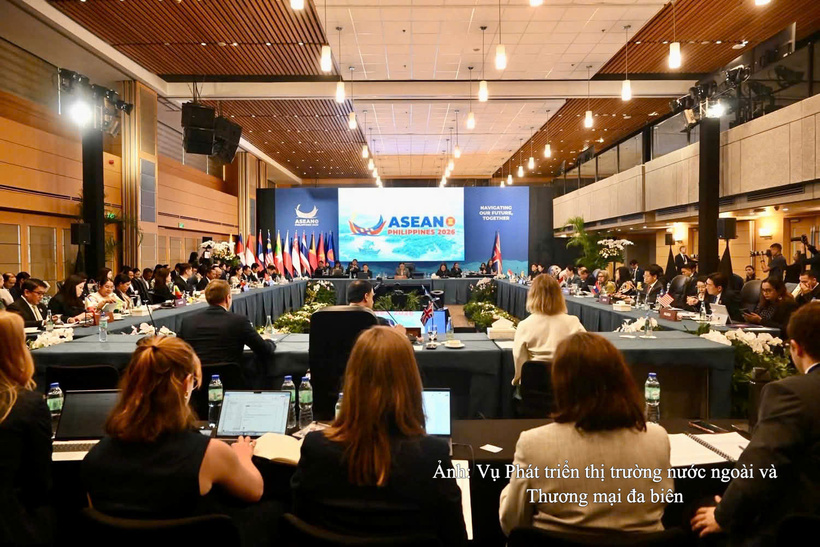
Overview of the meeting. Photo: MoIT
ASEAN promotes economic integration with partners
The meetings recorded a number of important outcomes, notably:
First, ASEAN and its partners will continue negotiations, upgrades and effective implementation of the network of free trade agreements between ASEAN and its partners. The Ministers affirmed their continued efforts to conclude negotiations on the ASEAN-Canada Free Trade Agreement (ACaFTA) and negotiations to review and upgrade the ASEAN-India Trade in Goods Agreement (AITIGA) in 2026. The Ministers also welcomed the launch of negotiations to upgrade the ASEAN-Republic of Korea Free Trade Agreement (AKFTA), with a view to substantially completing the negotiations by 2027; noted progress in the ratification process for the Protocol to Amend the ASEAN-China Free Trade Area Agreement (ACFTA) 3.0, with a view to the Protocol officially entering into force by the end of 2026; promoted the full implementation of the Second Protocol to Amend the ASEAN-Australia-New Zealand Free Trade Area (AANZFTA); and continued work related to the ASEAN-Hong Kong, China Free Trade Agreement. Within the RCEP framework, the Ministers agreed to begin preparations for the General Review of the Agreement in 2027 to ensure that RCEP remains relevant to changes in the regional and global economic environment.
Second, ASEAN and its partners will expand economic cooperation frameworks and programmes. The ASEAN-US meeting adopted the 2026-2027 TIFA Work Plan; ASEAN and Switzerland welcomed the completion of the ASEAN-European Free Trade Association (EFTA) Work Plan for 2026-2030; ASEAN and the UK adopted a Joint Ministerial Statement on Future Economic Cooperation and an updated economic work plan; and ASEAN and the Russian Federation adopted the Strategic Programme for Trade and Investment Cooperation for 2026-2035. ASEAN and the EU continued to advance the 2026-2027 Trade and Investment Work Programme, while ASEAN and Japan continued implementing the ASEAN-Japan Economic Co-Creation Action Plan for Innovative and Sustainable Future Design.
Third, supply chains, the digital economy, innovation, green transition, energy security, food security and sustainable development continued to be key areas of cooperation between ASEAN and its partners. The meetings discussed a range of initiatives to strengthen the resilience and connectivity of supply chains, cooperation in energy and critical raw materials, digital trade, digital transformation, the development of the green and circular economies. ASEAN and the EU continued efforts to develop ASEAN-EU Digital Trade Principles; ASEAN and Hong Kong, China exchanged views on connecting single-window mechanisms and piloting electronic certificates of origin; while ASEAN and the Republic of Korea discussed a proposal for cooperation on industrial supply chains and materials. Cooperation initiatives with Japan in energy, semiconductors and critical minerals were also noted.
At the meeting with WIPO, the Ministers discussed continued cooperation in intellectual property, innovation and capacity building, thereby helping ASEAN businesses and economies make more effective use of intellectual assets for development.
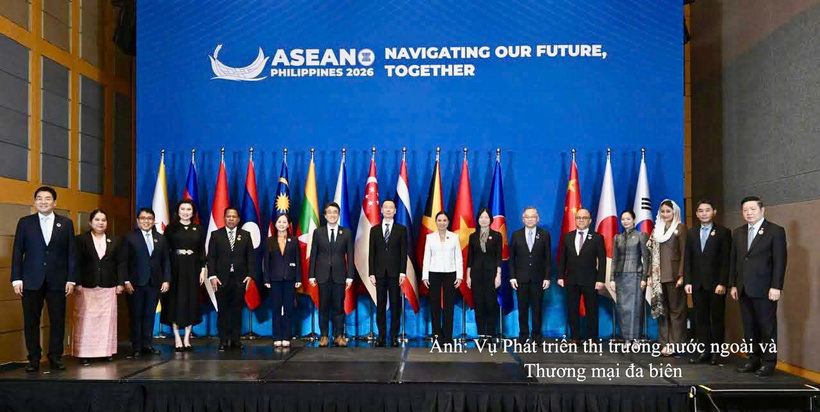
The 58th ASEAN Economic Ministers’ Meeting (AEM 58). Photo: MoIT
Fourth, RCEP continued to be identified as one of the important pillars of regional economic integration. In addition to promoting the implementation of the Agreement and increasing businesses' utilisation of its benefits, the 5th RCEP Ministerial Meeting agreed to establish an Accession Working Group (AWG) to consider the possibility of accession negotiations for four economies, namely Bangladesh, Chile, Hong Kong, China and Sri Lanka; while also promoting the process of exchanges with Uruguay to keep pace with the four other economies. The Ministers also tasked the RCEP Joint Committee with developing a document defining the scope of the General Review of RCEP, with a view to launching the process of upgrading the Agreement in 2027.
Fifth, ASEAN and its partners continued to affirm the importance of a rules-based multilateral trading system. At a number of meetings, the Ministers reaffirmed the central role of the World Trade Organization (WTO), stressing the need to continue WTO reform to improve its effectiveness and capacity to respond to changes in global trade. The parties also underscored the importance of dialogue and cooperation in addressing trade concerns and maintaining smooth trade flows and supply chains, particularly for energy and essential goods.
Sixth, economic cooperation between ASEAN and its partners has become increasingly closely linked to the practical needs of the business community. As part of the meeting series, the Ministers held a number of exchanges with business councils and associations, focusing on issues such as trade facilitation, improvement of the business environment, infrastructure development, the digital economy, energy, strengthening supply chain resilience and human resource development. Economic and technical cooperation programmes and capacity-building support continued to be pledged by partners to support ASEAN member states, particularly in implementing and making effective use of free trade agreements.
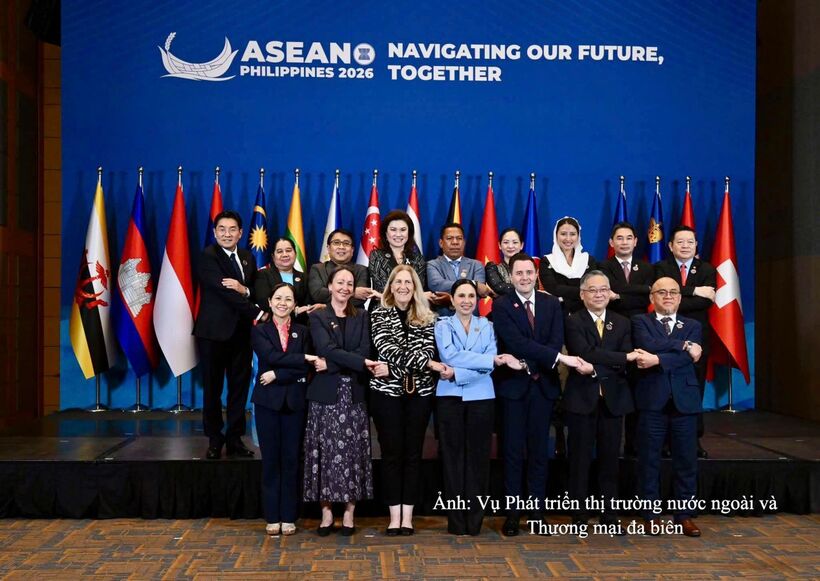
ASEAN economic cooperation with partners increasingly addresses the practical needs of the business community. Photo: MoIT
Vietnam actively contributes to ASEAN economic cooperation
At the meetings, Vietnam continued to make active contributions to discussions on economic relations between ASEAN and its partners. Vietnam stressed that, as the international economic environment remained complex, ASEAN needed to maintain solidarity and its central role while strengthening substantive cooperation with partners on the basis of balanced interests and mutual benefit. In particular, in its role as coordinator of ASEAN-EU economic cooperation, Vietnam continued to actively coordinate with ASEAN member states and the EU to advance economic cooperation programmes between the two regions.
Vietnam supported the continued effective implementation and upgrading of existing free trade agreements; the promotion of trade facilitation, connectivity and supply chain diversification; support for businesses, particularly small and medium-sized enterprises, in making better use of FTAs; and stronger cooperation in emerging areas such as the digital economy, green transition, innovation and sustainable development, thereby contributing to growth and shared prosperity in the region.
| The meetings achieved positive results, bringing to a close the series of the 58th ASEAN Economic Ministers Meeting and related meetings in Manila, the Philippines, from September 19 to 22, 2026, and paving the way for the ASEAN Summits scheduled to take place in mid-November 2026. |

